Torah Weekly - Parshat Lech Lecha






Parshat Lech Lecha
This issue is sponsored in merit of the complete recovery of
Yael Beracha bat Sarah Rayze
Overview
Ten generations have passed since Noach. Man has descended spiritually. In the year 1948 from Creation, Avram is born. By observing the world, Avram comes to the inescapable Truth of Hashem's existence, and thus merits that Hashem appear to him. At the beginning of this week's Parsha, Hashem tells Avram to leave his land, his relatives and his father's house and travel to an unknown land where Hashem will make him into a great nation. Avram leaves, taking with him his wife Sarai, his nephew Lot, their servants, and those whom they converted to faith in Hashem. When they reach the land of Canaan, Hashem appears to Avram and tells him that this is the land that He will give to his descendants. A famine ensues and Avram is forced to relocate to Egypt to find food. Realizing that his wife's beauty would cause his death at the hand of the Egyptians, Avram asks her to say that she is his sister. Sarai is taken to the Pharaoh, but Hashem afflicts the Pharaoh and his court with severe plagues and she is released unmolested. Avram returns to Eretz Yisrael (Canaan) with much wealth given to him by the Egyptians. During a quarrel over grazing rights between their shepherds, Avram decides to part ways with his nephew Lot. Lot chooses to live in the rich but corrupt city of Sodom in the fertile plain of the Jordan. A war breaks out between the kings of the region, and Sodom is defeated. Lot is taken captive. Together with a handful of his converts, Avram rescues Lot, miraculously overpowering vastly superior forces, but demurs from accepting any of the spoils of the battle. In a prophetic covenant, Hashem reveals to Avram that his offspring will be exiled to a strange land where they will be oppressed for 400 years, after which they will emerge with great wealth and return to Eretz Yisrael, their irrevocable inheritance. Sarai is barren and gives Hagar, her Egyptian hand-maiden, to Avram in the hope that she will provide them with a child. Hagar becomes arrogant when she discovers that she is pregnant. Sarai deals harshly with her, and Hagar flees. On the instruction of an angel Hagar returns to Avram, and gives birth to Yishmael. The Parsha concludes with Hashem commanding Avram to circumcise himself and his offspring throughout the generations as a covenant between Hashem and his seed. Hashem changes Avram's name to Avraham, and Sarai's name to Sarah. Hashem promises Avraham a son, Yitzchak, despite Avraham being ninety-nine years old and Sarah ninety. On that day, Avraham circumcises himself, Yishmael and all his household.
Insights
"And it was in the days of Amrafel, king of Shinar..." (14:1)
In the middle of this week's Parsha, the Torah seems to make a detour into the backwaters of Canaanite political history. For an entire chapter of 25 verses the Torah describes a war between the four kings and the five kings. Ostensibly, these events have little to do with the story of Avraham and the genesis of the Jewish People.
Or maybe there is more here than meets the eye...
The four kings and the five kings represent two inimical world views. The four kings represent a world-view where everything in creation is subsumed under the "forces of nature." This view holds that there is nothing else in this world - except this world. Four always denotes this-worldliness. There are four points of the compass. We speak of the "four winds." The world is composed of four elements: Earth, wind, fire, and water. The letter dalet which has the numerical value of four consists of two lines at right angles to each other, suggesting the four points of the compass.
You can look a this world as being no more than what can be contained within it - the four directions, the four winds, and the four elements.
Or you can look deeper and see that this world is focused on an Existence beyond itself. This is the world-view represented by the five kings.
Five in Hebrew is represented by the letter heh. If you look at the letter heh, you will see that it is composed of the letter dalet (which stands for four) plus the letter yud. Yud is a unique letter. It is the only letter which doesn't touch the line on which you write. It is no more than the smallest dot floating above the line. The letter heh is a pictogram of this world focused and revolving around that which is above this world - the dalet (the "four" of this world) with the yud at its axis.
Avraham fought on behalf of the five kings against the four kings. Avraham was the first person to look at this world and see an Existence beyond. If there was a manor, there had to be a "Lord of the manor."
After "Avram" fought the war against the four kings, G-d added a letter to his name. Not surprisingly, that letter was the letter heh. For Avraham represents all that the heh represents - that this world revolves around a Higher Existence.
It was also after the war against the four kings that G-d made a covenant with Avraham, the covenant of brit mila. Brit mila represents the sublimation of the physical to the metaphysical. It signifies that the human body is only complete when we dedicate it to its Maker.
The natural cycle of this world is seven. There are seven days in the week, seven notes in the scale, seven colors in the rainbow. Brit mila is performed on the eighth day because it symbolizes the dedication of the physical to that which is above the physical.
Just a little war between four kings and five kings. Just a little backwater historical chapter in the Canaanite history books...
"And there was a quarreling between the herdsman of Avram's livestock and the herdsmen of Lot's livestock." (13:7)
There's an interesting difference between the Greek and the Hebrew word for "womb." In Greek the "womb" is hysteros. The English word hysterical derives directly from hysteros. Generations of Western attitudes to women are revealed in this psycho-linguistic slip.
In Hebrew the word for womb - "rechem" - is directly related to the Hebrew word for mercy - rachamim. In the Jewish world-view, the defining quality of Woman is mercy.
"And there was a quarreling (riv) between the herdsman of Avram's livestock and the herdsmen of Lot's livestock." (13:7) The word for "quarreling" here is the masculine noun - riv. In the very next verse, the Torah uses a word from the same root - merivah - but in the feminine: "So Avram said to Lot: 'Please let there be no strife (merivah) between me and you.' " (13:8)
Why does the first verse use a masculine form and the second, a feminine?
Fruitfulness is female. Avram was suggesting to Lot that they separate before what was only a riv - a limited problem - proliferate into full-scale hostilities.
Sources:
- An Historical Backwater - Rabbi Eliezer Breitowitz in the name of The Maharal of Prague as heard from Rabbi CZ Senter
- Women's Lib - Shelah Hakadosh
Isaiah 40:27 - 41:16
In the time of Nimrod, the entire world, with its power-crazed worship of might, knew only battle and destruction. Enter Avraham. Avraham dedicated his life to proclaiming G-d's presence through every step and every action, bringing light into a world of darkness. When the world's nations were fighting, Avraham's sword and bow were left to gather dust. But when it became a necessity for Avraham to engage in battle, G-d caused him to be victorious. The biggest miracle was not that Avraham won the battle, but that he won the war. By remaining a peace loving servant of G-d, he won the war against the prevailing mentality of war and destruction.
So too, says the Prophet Yeshayahu, will Avraham's descendants return to Jerusalem in peace as G-d delivers us from our oppressors. However we must first be worthy of being called "the descendants of Avraham." Like Avraham, we must live our lives in peace and harmony 7fulfilling G-d's will with our every action.
"Every man would support his friend and say 'Be strong' ... as the hammer polisher supports the anvil striker" (Yeshayahu 41:6,7)
When the hammer strikes the anvil it appears that the purpose is to shape and form the anvil. In reality, the opposite it true, it is the hammer that is "knocked into shape." So, when a person helps and supports his friend, the giver often gains more than the recipient. The root of the word "ahavah" (love) is "hav" (to give). The more a person gives, the more he notices the development of love and other positive character traits within himself.
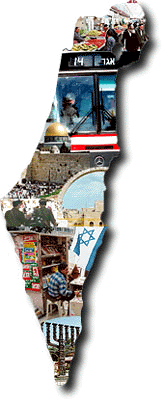  Selections from classical Torah sources which express the special relationship between the People of Israel and Eretz Yisrael MOUNT TAVOR When the Prophetess Devorah called upon Barak ben Avinoam in the name of Hashem to gather the thousand soldiers from the tribes of Naftali and Zevulun in order to free Israel from the yoke of Canaanite oppression, she directed him to confront the mighty forces led by Sisra at Mount Tavor. It was on this lofty mountain in the north of Eretz Yisrael that Hashem granted the outnumbered and outarmed Israelite forces a miraculous victory over their enemies. (Shoftim 4:6-15)
Because it was destined to be the scene of such a
great miracle, Mount Tavor asked that the Torah be given to Israel
upon it. Its claim was rejected, says the Midrash (Bereishet
Rabbah 89:1), because idols had been worshipped upon it.
In the end of days, however, it will regain its glory, for Hashem
will bring Mount Tavor together with Mount Sinai and Mount Carmel
and build the Beit Hamikdash upon them. (Midrash Tanchuma
36:6)
|
Written and Compiled by Rabbi Yaakov Asher Sinclair
General Editor: Rabbi Moshe Newman
Production Design: Eli Ballon
© 1999 Ohr Somayach International - All rights reserved. This publication may be distributed to another person intact without prior permission. We also encourage you to include this material in other publications, such as synagogue newsletters. However, we ask that you contact us beforehand for permission, and then send us a sample issue.
This publication is available via E-Mail
Ohr Somayach Institutions is an international network of Yeshivot and outreach centers, with branches in North America, Europe, South Africa and South America. The Central Campus in Jerusalem provides a full range of educational services for over 685 full-time students.
The Jewish Learning Exchange (JLE) of Ohr Somayach offers summer and winter programs in Israel that attract hundreds of university students from around the world for 3 to 8 weeks of study and touring.

 Copyright © 1999 Ohr Somayach International.
Send us Feedback.
Copyright © 1999 Ohr Somayach International.
Send us Feedback.Dedication opportunities are available for Torah Weekly. Please contact us for details.


