Torah Weekly - Parshas Bo






Parshas Bo
Overview
Hashem tells Moshe that He is hardening Pharaoh's heart so that through miraculous plagues the world will know for all time that He is the one true G-d. Pharaoh is warned about the plague of locusts and is told how severe it will be. Pharaoh agrees to release only the men, but Moshe insists that everyone must go. During the plague, Pharaoh calls for Moshe and Aharon to remove the locusts, and he admits he has sinned. Hashem ends the plague but hardens Pharaoh's heart, and again Pharaoh fails to free the Jewish people. The country, except for the Jewish People, is then engulfed in a palpable darkness. Pharaoh calls for Moshe and tells him to take all the Jews out of Egypt, but to leave their flocks behind. Moshe tells him that not only will they take their own flocks, but Pharaoh must add his own too. Moshe tells Pharaoh that Hashem is going to bring one more plague, the death of the firstborn, and then the Jews will leave Egypt. Hashem again hardens Pharaoh's heart, and Pharaoh warns Moshe that if he sees Moshe again, Moshe will be put to death. Hashem tells Moshe that the month of Nissan will be the chief month. The Jewish people are commanded to take a sheep on the 10th of the month and guard it until the 14th. The sheep is then to be slaughtered as a Pesach sacrifice, its blood put on their door-posts, and its roasted meat eaten. The blood on the door-post will be a sign that their homes will be passed-over when Hashem strikes the firstborn of Egypt. The Jewish People are told to memorialize this day as the Exodus from Egypt by never eating chametz on Pesach. Moshe relays Hashem's commands, and the Jewish People fulfill them flawlessly. Hashem sends the final plague, killing the first born, and Pharaoh sends the Jews out of Egypt. Hashem tells Moshe and Aharon the laws concerning the Pesach sacrifice, pidyon haben (redemption of the first born son) and tefillin.
Insights
"But if the household is too small for a lamb or kid, then he and his neighbor who is near his house shall take according to the number of people..." (12:4)
The Five Books of the Torah are the basis of the world's major legal systems. What is considered "human rights" by international jurisprudence is based on the Torah of Moshe. And yet, if you look at the written Torah, you'll be hard pressed to find a single mention of the word "rights." Obligations - that the Torah is full of. The obligations of a child to his parents; of a pupil to his teacher; of a community to the poor; of the individual to the community; obligations to the orphaned, to the sick, to the convert; the obligations of man to G-d. "Rights," however, are something that the Torah hardly mentions. Why?
The answer is - to the extent that I have obligations, you don't need rights.
You can write a legal code that enumerates people's rights: "that all men are created equal and endowed by their Creator with certain inalienable rights..." Or you can write a code which lists their obligations. Yet there is one big difference. When you talk about rights, you cast man in the role of a taker. But when you talk about obligations - you force him to realize that he has been put in this world to give.
Society reveals its nature through the choice of its metaphors. In English, we say "My duty calls." Meaning, I start off unencumbered by obligation. My obligation calls to me. I am over here and my duty is over there. In the Holy Tongue, we talk about a person being "yotzei chovaso" - "going out from his obligation." The Jew starts off by seeing himself obligated. He doesn't have to go anywhere to heed the call. Life and obligation are simultaneous.
In the above verse, the Torah instructs someone whose family is too small to consume an entire paschal lamb to find a neighbor to join his seder and help finish the Pesach lamb. Obviously, such a neighbor must have been someone not eating his own lamb, probably someone poor. The Torah could just have easily have written: "If you don't have a lamb yourself, go out and find someone who has too much food and eat at his table." However, it chose to phrase the obligation in terms of giving rather than taking.
"They shall eat the flesh on that night - roasted over the fire - and matzos with bitter herbs shall they eat it." (12:8)
Acommon misconception about Judaism is that it requires you to become a faceless automaton, mouthing the same prayers, performing the same actions, and dressed in the same clothes as everyone else.
Take a look around. Is there anything in this world more diverse than people? Everybody in this world is unique. No two people have the same face, the same ideas, the same talents, the same feelings or thoughts.
To think that Judaism requires conformity would be to accuse the Master of the world of extreme sloppiness (G-d forbid); after all, He created us all so palpably different. What a cosmic "waste of energy" to create such diversity, if all we're supposed to be automatons doing the same thing!
Rather, G-d created us all very different. And He wants us to be different. He wants us to be unique and express our individuality. In fact, if we don't use all the talents and gifts that we have been given, we will be called to task for this when we go before the "Supreme Court" when we leave this world.
The Pesach sacrifice was the first offering that the Jewish People were commanded to bring as a people. Whatever comes first contains the essence of all that follows. Just as DNA is the blueprint of a person's body, this first sacrifice was the DNA of all other sacrifices; it contains a fundamental message about the nature of sacrifices themselves.
Actually, the word sacrifice is a misnomer. Sacrifice means giving something up. The common idea about Judaism is you have to sacrifice - you have to give up something of your own personality.
The offerings brought to G-d on the Holy Altar epitomize service of G-d. The korban Pesach (the Pesach offering) was unique because you got the animal back. All the meat was given back to the person who brought the offering, to be eaten at his own seder table.
The korban Pesach epitomizes the nature of "sacrificing" to G-d. G-d doesn't want automatons. He wants our desire to serve Him with all our heart and with all our soul and with all our individuality. Not someone else's heart, soul or individuality. Once we are prepared to do this, once we are prepared to give ourselves to G-d without reservation, G-d gives us back all of ourselves without reservation.
"No uncircumcised male may eat of it." (12:48)
It's a sad fact that vastly more money is spent in America on Holocaust museums and memorials than on Jewish Education. The Holocaust is something that a Jew can identify with nationally, without having to inconvenience himself by having a relationship with G-d. It allows him to feel that he has paid his spiritual dues to Judaism by empathizing with his people. Then he can drive off to the Saturday afternoon game with a clear conscience.
One of the pre-requisites for eating the Pesach offering was bris mila (circumcision). What is the connection between the Pesach offering and bris mila?
A bris is a covenant. It comes from the root word "bar" meaning "to exclude." We have the same word in English, "to bar." A covenant implies a desire to enter into a unique and exclusive relationship. Only those who are part of the covenant are to share in this special relationship. Others are "barred." Both bris mila and the korban Pesach were brisos - the establishment of a special relationship between G-d and the Jewish People. But there's a difference. Bris mila is the covenant between G-d and the individual Jew. The korban Pesach is the covenant between G-d and the Jewish People as a nation.
It's significant that the Torah prohibits someone who does not have bris mila from partaking of the korban Pesach. The message is that the individual commitment to G-d must precede the individual's identification with the Jewish People. It's not enough to say: "I'm Jewish. I identify. I cry over the Holocaust. I send money to Israel." If we don't first commit ourselves to G-d, we lack an authentic commitment to the Jewish People as well.
Sources:
- Human Rights - Rabbi S.R.Hirsch, The Lehmann Haggada, Rabbi Uziel Milevsky, Rabbi Mordechai Perlman
- Self-Sacrifice - Rabbi S.R.Hirsch, Rabbi Mordechai Perlman
- March Of The Living - Rabbi Dovid Kaplan, Rabbi Uziel Milevsky
Yirmiyahu 46:13-28
"But you, be not afraid, My servant Yaakov, and be not frightened, O Israel, for I shall save you from afar, and your offspring from the land of their captivity, and Yaakov shall return and be tranquil, and secure, and none shall make him tremble." (46:27)
Neither the ovens of Europe nor the melting-pots of the New World have managed to obliterate the Jewish People. To be sure, in our days, we have witnessed massive casualties - a silent holocaust - walking/talking bodies that conceal charred remnants of Jewish souls.
The mystical writings tell us that Yaakov never died. Yaakov is eternal. He is like the moon: Whether engulfed by fire or physicality, just when he seems about to disappear, he renews himself. The Jewish People, the seed of Yaakov, live on, so Yaakov himself lives on "and Yaakov shall return and be tranquil, and secure, and none shall make him tremble."
In last week's Haftorah, the Prophet Yechezkel depicted the downfall of Egypt at the hands of the Babylonian king Nevuchadnetzar. This week, it is the Prophet Yirmiyahu who speaks of the judgment that will be executed on the Egyptians by the Babylonians.
The Haftorah also deals with the world-historic exile of the Jewish People, and inspires Israel with courage.
The prophet directs Israel to the only "good-luck charm" that will work in all times and all places. The name of that talisman is "eved Hashem" - "servant of G-d."
In spite of great suffering, the only sure protection against the storms of history will be to be a servant of G-d. For no one can be closer to the Master than he who is His servant at all times and in all places, unconditionally.
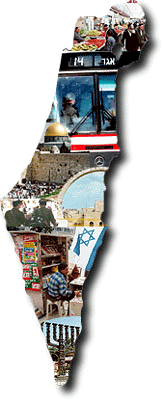  Selections from classical Torah sources which express the special relationship between the People of Israel and Eretz Yisrael BEIT SHE'ARIM Catacombs, the ruins of a synagogue and an ancient olive press are all that remain of this ancient city which was an important town in Israel and once served as the seat of the Sanhedrin. In reference to the Torah's command "Justice, justice shall you pursue" the Talmud advises "follow Rebbi (Rabbi Yehuda Hanassi, the compiler of the Mishnah) to Beit She'arim." During his illness this great sage was moved to the healthier climate of Tzipori, but a grave was reserved for him in Beit She'arim. Inscriptions found on graves in the catacombs indicate that two of his sons were also buried there.
The synagogue, whose remains indicate that it was
among the largest in the country, was destroyed by the Romans
in the fourth century as a punishment for the resistance of the
town's residents to Roman rule.
|
Written and Compiled by Rabbi Yaakov Asher Sinclair
General Editor: Rabbi Moshe Newman
Production Design: Eli Ballon
© 1999 Ohr Somayach International - All rights reserved. This publication may be distributed to another person intact without prior permission. We also encourage you to include this material in other publications, such as synagogue newsletters. However, we ask that you contact us beforehand for permission, and then send us a sample issue.
This publication is available via E-Mail
Ohr Somayach Institutions is an international network of Yeshivot and outreach centers, with branches in North America, Europe, South Africa and South America. The Central Campus in Jerusalem provides a full range of educational services for over 685 full-time students.
The Jewish Learning Exchange (JLE) of Ohr Somayach offers summer and winter programs in Israel that attract hundreds of university students from around the world for 3 to 8 weeks of study and touring.

 Copyright © 1999 Ohr Somayach International.
Send us Feedback.
Copyright © 1999 Ohr Somayach International.
Send us Feedback.Dedication opportunities are available for Torah Weekly. Please contact us for details.


