Torah Weekly - Parshas Vayera






Parshas Vayera
Overview
Three days after performing bris mila on himself, Avraham is visited by Hashem. When three angels appear in human form, Avraham rushes to show them hospitality by bringing them into his tent, despite this being the most painful time after the operation. Sarah laughs when she hears from them that she will bear a son next year. Hashem reveals to Avraham that He will destroy Sodom, and Avraham pleads for Sodom to be spared. Hashem agrees that if there are fifty righteous people in Sodom, He will not destroy it. Avraham "bargains" Hashem down to ten righteous people. However, not even ten can be found. Lot, his wife and two daughters are rescued just before sulfur and fire rain down on Sodom and her sister cities. Lot's wife looks back and is turned into a pillar of salt. Lot's daughters fear that, as a result of the destruction, there will be no husbands for them. They decide to get their father drunk and through him to perpetuate the human race. From the elder daughter, Moav is born, and from the younger, Ammon. Avraham moves to Gerar, where Avimelech abducts Sarah. After Hashem appears to Avimelech in a dream, he releases Sarah and appeases Avraham. As promised, a son, Yitzchak, is born to Sarah and Avraham. On the eighth day after the birth, Avraham circumcises him as Hashem commanded. Avraham makes a feast the day Yitzchak is weaned. Sarah tells Avraham to banish Hagar and Hagar's son Yishmael because she sees in him signs of degeneracy. Avraham is distressed at the prospect of banishing his son, but Hashem tells him to listen to whatever Sarah tells him to do. After nearly dying of thirst in the desert, Yishmael is rescued by an angel and Hashem promises that he will be the progenitor of a mighty nation. Avimelech enters into an alliance with Avraham when he sees that Hashem is with him. In a tenth and final test, Hashem instructs Avraham to take Yitzchak, who is now 37, and to offer him as a sacrifice. Avraham does this, in spite of ostensibly aborting Jewish nationhood and contradicting his life-long preaching against human sacrifice. At the last moment, Hashem sends an angel to stop Avraham. Because of Avraham's unquestioning obedience, Hashem promises him that even if the Jewish People sin, they will never be completely dominated by their foes. The Parsha ends with the genealogy and birth of Rivka.
Insights
"And it was that when G-d destroyed the cities of the plain that G-d remembered Avraham; so He sent Lot from amidst the upheaval when He overturned the cities..." (19:29)
Predictions of Jewish continuity are dire. We face a situation where intermarriage in the United States has topped 50%. Simply put, this means that most Jews marry non-Jews. To combat this situation, dedicated people are making tremendous efforts to dissuade such relationships by teaching what Torah is, and why a Jew should live by its precepts.
When a Jew begins observing Torah, major changes may result in his lifestyle. This is rarely easy. Spiritual awakening is often accompanied by difficult adjustments: Tensions may arise between a person who becomes religious and other family members; or the person may want to change a present job for one which makes it easier to observe the Torah fully.
To what extent is someone involved in "saving souls" also obliged to become involved in these physical problems?
In the above verse, it's apparent that G-d saved Lot because He remembered Avraham. Isn't this a non-sequitur? Shouldn't G-d have rescued Lot because He remembered Lot?
If not for Avraham, Lot would probably still have been living comfortably, minding his own business in his hometown of Charan together with the rest of his family. He may never have had the spiritual advantages of being close to a tzaddik, a righteous person, like Avraham, but he would also not have had any of the problems that this led to. For it was Lot's kindness in agreeing to accompany Avraham which eventually led to Lot's living in Sodom. Thus Lot was saved in the merit of Avraham, for had it not been for Avraham, Lot would never have been in the mortal danger of Sodom in the first place.
If, in bringing people close to Judaism, we uproot them from their birthplaces and their lifestyles, it is not enough for us to attend to their spiritual needs, we must also involve ourselves in their physical requirements; for had it not been for our intervention, they would probably be living in a world which, for all its spiritual dangers, was a lot more familiar than the one they subsequently find themselves in.
"Fear not for G-d has heard the cry of the youth in his present state." (lit. as he was there) (21:20)
The Torah plumbs the psychological depths of Man. In this week's Parsha, Avraham banishes Hagar and her son Yishmael. Avraham supplies them adequately, but they lose their way, Yishmael falls ill, and they run out of water. They find themselves on the brink of dying from thirst in the desert and Yishmael prays to G-d to save them.
The Torah says that despite the fact that Yishmael's descendants would in the future murder Jews, nevertheless, G-d judged him "as he was there." At that point in time Yishmael was worthy of being saved, and he was judged only according to his present merit.
A fascinating contradiction arises between this idea and another Torah concept: In Parshas Ki Seitze, the Torah instructs us regarding a "wayward and rebellious son." This is a boy who shows specific signs of incipient moral degeneracy. He is put to death, not because of his current behavior, but rather because he will inevitably rob and kill to satisfy his appetites. The Torah instructs that he be executed before reaching this future depravity.
The question thus arises, why wasn't Yishmael judged in the same way as the wayward and rebellious son? Why wasn't he judged according to his evil progeny, and condemned immediately? Why was he judged "as he was there?"
Let's try and answer this conundrum with another Torah concept. A Torah scroll must be written with black ink on parchment. If the ink is another color, the Torah scroll is invalid.
What if the ink is a type which starts off black but later turns red? Is it permitted to publicly read the Torah while the writing is still black? After all, at that point the ink looks identical to permanent black ink.
The answer is that a Torah scroll written with ink that eventually changes color is invalid even when the ink is still as black as night.
With this concept we can offer an answer to our perplexing contradiction:
The wayward and rebellious son is like the black ink which is going to turn red. We look at him as though he were really red ink masquerading as black. His true nature has yet to become visible, but that's who he is now. It's not that he will change into a highway robber. He is a highway robber now.We just can't see it yet. So the Torah judges him according to his future behavior.
However, the descendants of Yishmael did not represent Yishmael's essence at the time he prayed to G-d when he was dying of thirst. At that point, Yishmael was still righteous, and thus he was saved.
Maybe this is one of the reasons that on Rosh Hashana we read in synagogue this section from this week's Parsha about Yishmael.
On Rosh Hashana, the Jewish People stand in the dock of cosmic justice. For our past flawed actions, hopefully we have repented. As far as the future is concerned, we have taken upon ourselves an earnest undertaking not to repeat our past mistakes. However, in spite of our most sincere intentions, it is known before Hashem that we will stumble again.
How can we hope for forgiveness?
At our core, the Jewish People are "kosher." At our deepest center we want to do Hashem's will. Our transgressions are external to our essence. They are like caked mud that sticks to us from the outside. If we do fall again in the future, it is not because we are like the rebellious son with our true nature surfacing. Rather, we are saying to Hashem: "We are in a sense like Yishmael. Now our hearts are perfect in repentance. What may happen in the future is not of our essence. Our essence is as we are, here and now."
Sources:
- Body and Soul - Ramban
- Permanent Ink - Rabbi S.Y. Zevin
Melachim II 3:1-37
It's ironic that the world's view of the Jewish creditor is personified by Shakespeare's Shylock in the Merchant of Venice. When the world thinks of a Jewish creditor, it conjures up someone who will squeeze the law to its utmost in order to exact his "pound of flesh."
Ironically, it was not so long ago that the Torah was the only system in which a creditor has absolutely no rights over the physical person of a debtor. The spirit of the Torah insures a poor debtor against the unfeeling or inconsiderate use of a lien on the debtor's chattels. And even where the protection of the debtor stops, the obligation on the creditor to love his fellow man, the debtor, begins. For we are all the children of Avraham and Sarah. Such is the righteous charity of Avraham in contrast to the Sodomite insistence on the very last penny which can be wrung out through litigation - or the last ounce of flesh.
Just as in the Parsha the angel promises Sarah that she will conceive and give birth to a child, similarly in the Haftorah, the Prophet Elisha promises a barren Shunamite woman that she will give birth.
The child dies, and is resurrected by Elisha, who revives him by placing himself on the lifeless child, implanting his own soul into the boy.
This is a lesson for all teachers: One has to in-spire - to breathe one's own life into one's pupils - to give over of one's own soul. Nothing less than this will do.
Just as Avraham and Sarah were both old and yet Hashem gave them a child, similarly in this week's Haftorah, Hashem grants the Shunamite woman and her husband a child.
Why then does the Haftorah begin with an entirely different incident, the miracle of the oil filling pitcher after pitcher, until the penniless widow of the prophet Ovadia became rich? What is the connection between these three women?
The answer is that they all excelled in chesed, in kindness to others. To this day, Sarah is a role-model of the Jewish woman. Her life was an unceasing labor of welcoming guests and teaching them about Hashem. Ovadia's widow was also a heroine of such kindness, as depicted in the Haftorah, and the same was true of the Shunamite woman. All three cast the mold, the archetype of the Jewish woman for all generations.
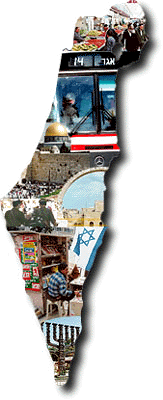  Selections from classical Torah sources which express the special relationship between the People of Israel and Eretz Yisrael JERUSALEM - YERUSHALAYIM "Malki-Tzedek, King of Shalem, brought out bread and wine." (Bereishis 14:18) "Avraham called that place Hashem Yireh." (Bereishis 22:14) Both of these saintly men - Malki-Tzedek, who was Shem, son of Noach, and his descendant Avraham - were referring to the site upon which stands Jerusalem (whose Biblical name is Yirehshalem). When Hashem wished to name His holy city, He faced, as it were, a Divine dilemma. "If I call it Yireh like Avraham did, the righteous Shem will feel slighted, and if I call it Shalem like Shem did, the righteous Avraham will feel slighted. I will therefore call it Yireh-Shalem like both of them called it." Shalem means both peace and perfection, while Yireh, as Targum Onkelos translates, means human service of Hashem. Only when man serves Hashem can he hope to achieve the peace and perfection symbolized by Yirehshalem.
(Bereishis Rabbah 56:10)
|
Written and Compiled by Rabbi Yaakov Asher Sinclair
General Editor: Rabbi Moshe Newman
Production Design: Eli Ballon
© 1998 Ohr Somayach International - All rights reserved. This publication may be distributed to another person intact without prior permission. We also encourage you to include this material in other publications, such as synagogue newsletters. However, we ask that you contact us beforehand for permission, and then send us a sample issue.
This publication is available via E-Mail
Ohr Somayach Institutions is an international network of Yeshivot and outreach centers, with branches in North America, Europe, South Africa and South America. The Central Campus in Jerusalem provides a full range of educational services for over 685 full-time students.
The Jewish Learning Exchange (JLE) of Ohr Somayach offers summer and winter programs in Israel that attract hundreds of university students from around the world for 3 to 8 weeks of study and touring.

 Copyright © 1998 Ohr Somayach International.
Send us Feedback.
Copyright © 1998 Ohr Somayach International.
Send us Feedback.Dedication opportunities are available for Torah Weekly. Please contact us for details.


