Torah Weekly - Parshas Vayechi







Parshas Vayechi
Overview
After 17 years in Egypt, Yaakov senses his days drawing to a close and summons Yosef. He makes Yosef swear to bury him in the cave of Machpela, the burial place of Adam and Chava, Avraham and Sarah, Yitzchak and Rivka. Yaakov becomes ill and Yosef brings to him his two sons, Efraim and Menashe. Yaakov elevates Efraim and Menashe to the status of his own sons, thus giving Yosef a double portion which removes the status of the first-born from Reuven. As Yaakov is blind from old age, Yosef leads his sons close to their grandfather. Yaakov kisses and hugs them. He had not thought to see his son Yosef again, let alone Yosef's children. Yaakov begins to bless them, giving precedence to Efraim, the younger, but Yosef interrupts him and indicates that Menashe is the elder. Yaakov explains that he intends to bless Efraim with his strong hand because Yehoshua will descend from him, and Yehoshua will be both the conqueror of Eretz Yisrael and the teacher of Torah to the Jewish People. Yaakov summons the rest of his sons in order to bless them as well. Yaakov's blessing reflects the unique character and ability of each tribe, directing each one in its unique mission in serving Hashem. Yaakov passes from this world at the age of 147. A tremendous funeral procession accompanies his funeral cortege up from Egypt to his resting place in the cave of Machpela in Chevron. After Yaakov's passing, the brothers are concerned that Yosef will now take revenge on them. Yosef reassures them, even promising to support them and their families. Yosef lives out the rest of his years in Egypt, seeing Efraim's great-grandchildren. Before his death, Yosef foretells to his brothers that Hashem will redeem them from Egypt. He makes them swear to bring his bones out of Egypt with them at that time. Yosef passes away at the age of 110 and is embalmed. Thus ends Sefer Bereishis, the first of the five Books of the Torah.
Insights
"And may they proliferate abundantly like fish within the land." (48:16)
Fish don't do too well on land. Take a fish out of water and you won't have to wait too long for it to become an ex-fish. Deceased. No more.
Why, then, did Yosef bless Efraim and Menashe that they would proliferate "like fish within the land."
The Jewish People take to Eretz Yisrael like a fish to water. In exile, the natural result should be that we flounder around and become asphyxiated by the hostile atmosphere. Yosef was giving Efraim and Menashe a blessing that even when they were breathing the spiritual poison gas of exile - "within the land" - they would still flourish like a fish in water.
"And Yaakov lived..." (47:28)
As every child knows, the school terms goes on forever. Or at least it seems to. The amount of time left till vacation seems like a life term in Alcatraz. Or almost. Almost any affliction, school included, is bearable if we know when it will finish. What really makes it bearable, however, is not so much that we know when the term will end, rather that it will end. Similarly, when we're sitting in the dentist's chair with what feels like a pneumatic drill in our mouth and the dentist says "Just another couple of seconds..." our solace comes, not so much from knowing when the drilling will end, but rather the fact that it will end.
This week's Parsha is unique. It's the only Parsha in the Torah that is "sealed." Rashi tells us that Yaakov wanted to reveal "The End," the time when mashiach would come, when history would draw to a close. G-d prevented him. The secret remains as sealed as this week's Parsha.
Why wasn't Yaakov allowed to reveal when the final redemption would come? Why wasn't he permitted to sweeten the bitterness of thousands of years of exile? If the Jewish People would have known the date, the time when G-d would finally redeem them, wouldn't all the years of waiting be so much more bearable?
Maybe G-d didn't want Yaakov to reveal the End, not so much because we would then know when the End would be, but rather that there would be an End.
Not a leaf falls in the forest unless its descent is decreed on High. Not a blade of grass grows without the compulsion of G-d's spiritual messengers. The only thing which is truly ours is the decision to fear G-d. We can look at this world as happenstance with no Beginning and no End. Or we can lift our eyes to Heaven and realize Who created all this.
"Yosef took the two of them - Efraim with his right hand, to Israel's left, and Menashe with his left hand, to Israel's right... But Israel extended his right hand and laid it on Efraim's head though he was the younger, and his left hand on Menashe's head." (48:13-14)
Strange things happen to people when they look in a mirror. Their normal expression becomes contorted. An eyebrow is raised. Lips are pursed. The head is turned ever so slightly to the right and then to the left.
When we look in the mirror, we see ourselves not so much as we really are, but as we'd like to be: Head held a little higher, the posture more erect and holding in our breath so that clothes don't betray the evidence of one too many slices of chocolate cake.
When we look at other people, however, our perspective changes radically. Rather than emphasize the positive, we tend to scrutinize their defects and lay the stress on what's wrong with them. What we see in ourselves as prudent, in others becomes stingy. Where we are vivacious, others are loud.
When Yaakov blesses Yosef's children Efraim and Menashe, Yaakov crosses his hands. He places his right hand, his stronger hand, on the younger son Efraim, and his weaker left hand on Menashe, the elder son. But wouldn't it have been easier for Yaakov to have told Efraim to stand opposite his right hand and Menashe opposite his left? That way there would have been no need for him to cross his hands.
The right side symbolizes strength and importance. The left symbolizes weakness and insignificance. When we look at ourselves in the mirror, our right hand is reflected on the right side of the mirror. In other words, our strengths are reflected as being important. Our left hand, the hand that characterizes weakness, corresponds to our left hand in the mirror. Meaning that we see our weaknesses as insignificant. However, when we stand opposite someone else, our right hand corresponds to their left hand, meaning we emphasize their shortcomings. Our left hand is opposite their right - we play down their strengths.
This is what Yaakov was teaching the two brothers Efraim and Menashe. When you look at each other, use the eyes that you use for yourself. See the other person's weakness as secondary, and his virtues as being his essence.
Sources:
- Fish Out Of Water - Chasam Sofer as heard from Rabbi Nota Schiller
- Mirror, Mirror - Rabbi Chaim M'Velozhin in Beis Yitzchak, Rabbi Chaim Zvi Senter
Haftorah: Kings I 2:1 - 12
As in the Parsha where we read the final will and testament of Yaakov, so too the Haftorah deals with the final words of King David. David commands his 12 year old son, Shlomo, to act as a man of wisdom and piety despite his tender years, and to guard and uphold the Torah. David promises Shlomo that if he will serve Hashem in truth, with all his heart and soul, he will merit that all the kings of Israel will descend from him. Just as Yaakov illuminated the path to make his children into a people, King David illuminates the path that will make Shlomo the father of kings. However, there is a striking difference between the death-bed scene of Yaakov and that of King David. When Yaakov took leave of this world, he summoned all 12 of his sons, whereas David calls for only Shlomo, for he alone was a comfort to him and worthy to inherit the Davidic line.
"I go the way of all the earth; be strong and become a man."
We live our lives as though we were immortal. How much of the time do we think about where we are going? How often do we pause and ponder in front of Whom we will ultimately have to account for our every thought and deed?
In this verse, King David commands three things to his son Shlomo. The first two are obvious: "Be strong" and "become a man." The third lies in the beginning of the sentence "I go the way of all the earth." David is not merely describing his end, he is actively commanding Shlomo to remember these words constantly: "I go the way of all the earth."
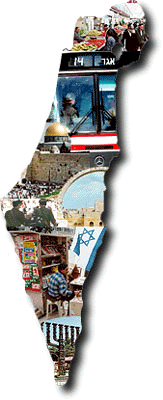  Selections from classical Torah sources which express the special relationship between the People of Israel and Eretz Yisrael BNEI BRAK Mentioned as one of the cities in the portion of the Tribe of Dan (Yehoshua 19:45), Bnei Brak is famous in the Talmud (Sanhedrin 32b) as the seat of Rabbi Akiva's court, and in the Pesach Haggada as the site of the all-night Pesach Seder of Rabbi Akiva and his distinguished colleagues. The city had an agricultural dimension as well, as appears from the account (Kesuvos 111b) of the Sage Rami bar Yechezkel who declared that he understood the meaning of the Torah's description of Eretz Yisrael as a "land flowing with milk and honey" after witnessing a scene during a visit to Bnei Brak. He observed goats grazing beneath fig trees. The honey oozing from the very ripe figs merged with the milk dripping from the goats and formed a stream of milk and honey.
The Bnei Brak of today was established in 1924 by charedi Jews from Poland, and is famed
for its many yeshivos and Chassidic communities.
|
Written and Compiled by Rabbi Yaakov Asher Sinclair
General Editor: Rabbi Moshe Newman
Production Design: Eli Ballon
© 1999 Ohr Somayach International - All rights reserved. This publication may be distributed to another person intact without prior permission. We also encourage you to include this material in other publications, such as synagogue newsletters. However, we ask that you contact us beforehand for permission, and then send us a sample issue.
This publication is available via E-Mail
Ohr Somayach Institutions is an international network of Yeshivot and outreach centers, with branches in North America, Europe, South Africa and South America. The Central Campus in Jerusalem provides a full range of educational services for over 685 full-time students.
The Jewish Learning Exchange (JLE) of Ohr Somayach offers summer and winter programs in Israel that attract hundreds of university students from around the world for 3 to 8 weeks of study and touring.

 Copyright © 1999 Ohr Somayach International.
Send us Feedback.
Copyright © 1999 Ohr Somayach International.
Send us Feedback.Dedication opportunities are available for Torah Weekly. Please contact us for details.


