Torah Weekly - Bo



Bo
Overview
Hashem tells Moshe that He is hardening Pharaoh's heart so that through miraculous plagues the world will know for all time that He is the one true Gd. Pharaoh is warned about the plague of locusts and is told how severe it will be. Pharaoh agrees to release only the men, but Moshe insists that everyone must go. During the plague, Pharaoh calls for Moshe and Aharon to remove the locusts, and he admits that he has sinned. Hashem ends the plague but hardens Pharaoh's heart, and again Pharaoh fails to free the Jewish people. The country, except for the Jewish People, is then engulfed in a palpable darkness. Pharaoh calls for Moshe and tells him to take all the Jews out of Egypt, but to leave their flocks behind. Moshe tells him that not only will they take their own flocks, but Pharaoh must add his own too. Moshe tells Pharaoh that Hashem is going to bring one more plague, the death of the first born, and then the Jews will leave Egypt. Hashem again hardens Pharaoh's heart, and Pharaoh warns Moshe that if he sees Moshe again, Moshe will be put to death. Hashem tells Moshe that the month of Nissan will be the chief month. The Jewish people are commanded to take a sheep on the 10th of the month and guard it until the 14th. The sheep is then to be slaughtered as a Pesach sacrifice, its blood to be put on their door-posts, and its roasted meat to be eaten. The blood on the door-post will be a sign that their homes will be passed-over when Hashem strikes the first born of Egypt. The Jewish People are told to memorialize this day as the Exodus from Egypt by never eating chametz on Pesach. Moshe relays Hashem's commands, and the Jewish People fulfill them flawlessly. Hashem sends the final plague, killing the first born, and Pharaoh sends the Jews out of Egypt. Hashem tells Moshe and Aharon the laws concerning the Pesach sacrifice, pidyon haben (the redemption of the first born son) and tefillin.
Insights
"...A festival of Hashem for us." (10:9)
It's said that caterers don't like doing Jewish weddings.
There's not a lot of profit in catering the food for a wedding. There's not much of a mark-up. The majority of the profit is in the alcoholic beverages. And Jews are notoriously small drinkers.
Statistics show that Jews have the lowest incidence of alcoholism of any ethnic group.
Why?
A Jewish boy first encounters wine when he's eight days old. The mohel (one who performs the circumcision) usually puts a few drops of wine in the baby's mouth. In other words, the first contact that this little fellow has with wine is in the context of a mitzvah. This experience is fortified throughout his childhood. Every Friday night and Shabbat morning, the Jewish child hears kiddush said over a glass of wine. And he himself will be given some to taste. At the departure of Shabbat, in the havdala service, wine will again play a central role.
On festivals, wine figures prominently. And on Purim, one of the mitzvos of the day mandates drinking until one cannot distinguish between Mordechai the blessed and Haman the accursed! On Pesach the child will see his parents drink four cups of wine, symbolizing the four aspects of freedom from the servitude of Egypt.
A Jewish child isn't afraid of alcohol. He doesn't see it as a method of escapism - something to drown his sorrows - rather, it connotes the blending of the physical and the spiritual. Its context is exclusively positive.
Judaism, unlike some religions, doesn't preach asceticism as the ideal route to spirituality. It does not see this world as a minefield where physicality exists to trip man up. Rather, the world is a resource. You can allow it to dominate you, or you can take everything in the physical world and use it to come closer to G-d.
When Moshe told Pharaoh they were going to make a Festival of Hashem, he said it was a "festival of Hashem for us."
To be a holy Jew, you don't mortify the flesh, you elevate it. Every festival of Hashem is also "for us." It is for us to partake of the wonderful gifts of this world and, through experiencing the world's pleasures in their correct context, reach a higher appreciation of the One who sends us all these exquisite gifts.
L'Chaim! To Life!
"...And you shall not break a bone of it (the Pesach offering)." (12:46)
In the Second World War, during the "blitz" on London, large numbers of families were evacuated to safer areas. Sometimes, the family itself was divided, with some children evacuated to places as far as Canada, while other children stayed with their parents in the relative safety of the English countryside.
One can well imagine the tremendous outpour of emotion when the war ended and these families were reunited. But after the initial overwhelming emotion, it became clear that the bond between the parents who had stayed with their children was far closer than their relationship with those children from whom they had been separated for more than four years.
We think that because we love our children we give to them. The reverse, however, is closer to the truth: Because we give to our children, we love them. Every time you get up in the middle of the night to get your child a glass of water or to change a diaper, you are giving, and that leads to love. What was lacking in the relationship between the parents and their evacuated children? Four years of not getting up in the middle of the night to give them a glass of water.
The same is true in our relationship with Hashem: People often say "I would love to have your faith! But I just don't feel it!" The truth of the matter is that doing leads to feeling. When you "give to Hashem" by doing what Hashem wants you to do, it's the spiritual equivalent of getting up in the middle of the night to give your child a glass of water.
That is why Hashem gives us so many mitzvos to help us remember the Exodus. If we just needed a memorial, wouldn't eating a little matza be enough? But Hashem gives us a multitude of mitzvos so that we will be deeply affected emotionally, and our hearts will be drawn to a powerful love for our Creator.
"And it shall be a sign upon your arm, and an ornament between your eyes, for with a strong hand Hashem took us out of Egypt." (13:16)
When Hashem created the world, there was no doubt it was He who had brought everything into existence, that He knew all that was going on in the world and that He was involved in the smallest event that happens in this world.
From the time of Enosh, Adam's grandson, people started to make mistakes about G-d. Some people denied G-d altogether.
Others conceded the existence of a divine power, but said that he was so removed and exalted that he only had knowledge of the spiritual realm, but didn't know what was going on down in this world.
Yet a third group admitted to a god who knows what is happening in the lower realms, but he isn't interested in what we do. In other words, he created the Universe, and then, as it were, went off to play golf.
G-d decided once and for all to quash these mistakes. Through a series of miraculous events, by altering nature, G-d would show that He creates and controls nature.
The plagues of Egypt were these miraculous events.
But how can the mere alteration of nature prove that G-d created nature? The fact that I can fix a car doesn't prove that I can make one.
To answer this, we have to understand the nature of this change in nature on a deeper level.
When G-d created the world, He did so with Ten Utterances: "In the beginning..." "Let there be light..." etc. The Ten Plagues were the reverse of the Ten Utterances. They were their negative counterparts. The first utterance corresponds to the tenth plague, the second utterance to the ninth plague, etc.
For example: The second utterance, "Let there be light" corresponds to the ninth plague, the plague of darkness. The plague of darkness was not just an absence of light; rather, G-d changed the whole order of Creation, so that light became the absence of darkness. Instead of there being photons of light which pierce a black nothingness, during the plague of darkness photons of darkness pierced a white nothingness.
Now we can understand why these plagues showed that G-d creates and controls nature. For these were not diversions of the normal current of nature, but rather the re-creation of nature itself.
Yirmiyahu 46:13 - 28
"As Tavor is fixed among the mountains and Carmel traveled across the sea...." (46:18)
When the Almighty was about to give the Torah, two mountains, Mt. Tavor and Mt. Carmel, had a great desire that the Torah be given on them. So great was their desire that the angel appointed over mountains began moving them towards Mt. Sinai. Nevertheless, Hashem chose Mt. Sinai as the site of the giving of the Torah. These two mountains, however, were recompensed for their disappointment by being uprooted and replanted in Eretz Yisrael.
Later, the Jews were miraculously saved on Mt. Tavor in the time of the Prophetess Devorah, while on Mt. Carmel Hashem's unity was proclaimed in the time of Eliyahu. If these two mountains were moved to Eretz Yisrael because of their intense longing for the Torah to be taught on them even for the brief moments of the giving of the Torah, then how much more will all the world's Batei Midrash (study-houses), where the Torah has been studied continuously for over 3,000 years, merit to be transported to Eretz Yisrael in the coming epoch!
Sources
- A Multitude Of Mitzvos - Sefer HaChinuch, Rabbi Eliyahu Dessler
- Night And Day - Ramban, Reb Tzadok HaCohen
|
Selections from classical Torah sources which express the special relationship between the People of Israel and Eretz Yisrael | |
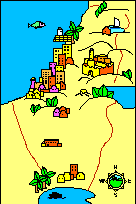 |
Mount Hermon, "the Israeli Alps," which lies on Israel's border with the Amorites and the Tzidonites, is called by several other names in the Torah: Siryon, Senir, and Sion. These names were given to it by these neighboring nations: The Tzidonites called it Siryon, and the Amorites called it Senir. (Devarim 3:9) The Torah relates this to show how beloved Eretz Yisrael was even to the other nations. The names Siryon and Senir were originally names of mountains within the borders of the Land of Israel. The nations loved Eretz Yisrael so much that when they built cities on Mount Hermon, they graced those cities with names of mountains in Eretz Yisrael. This appreciation takes on a special dimension when we note that Senir means "a snow-capped mountain." Even the uninhabitable mountain peaks of Eretz Yisrael were so beloved by the nations that they called their great mountain-top cities by that name.
(Chullin 60b)
|
The Love of the Land series is also available in one document in these formats:
![[HTML]](/tw/5758/shmos/../../../image/html.gif)
![[Word]](/tw/5758/shmos/../../../image/worddoc.gif)
![[PDF]](/tw/5758/shmos/../../../image/pdficon.gif) Explanation of these symbols
Explanation of these symbols
Written and Compiled by Rabbi Yaakov Asher Sinclair
General Editor: Rabbi Moshe Newman
Production Design: Lev Seltzer
HTML Design: Eli Ballon
© 1998 Ohr Somayach International - All rights reserved. This publication may be distributed to another person intact without prior permission. We also encourage you to include this material in other publications, such as synagogue newsletters. However, we ask that you contact us beforehand for permission, and then send us a sample issue.
This publication is available via E-Mail
Ohr Somayach Institutions is an international network of Yeshivot and outreach centers, with branches in North America, Europe, South Africa and South America. The Central Campus in Jerusalem provides a full range of educational services for over 685 full-time students.
The Jewish Learning Exchange (JLE) of Ohr Somayach offers summer and winter programs in Israel that attract hundreds of university students from around the world for 3 to 8 weeks of study and touring.
Ohr Somayach's Web site is hosted by TeamGenesis
 Copyright © 1998 Ohr Somayach International.
Send us Feedback.
Copyright © 1998 Ohr Somayach International.
Send us Feedback.Dedication opportunities are available for Torah Weekly. Please contact us for details.


