Torah Weekly - Vayeitzei







Vayeitzei
Overview
Fleeing from Esav, Yaakov leaves Be'er Sheva and sets out towards Charan, the home of his mother's family. After a fourteen year stopover in the Yeshiva of Shem and Ever, he resumes chis journey and comes to Mount Moriah, the place where his father Yitzchak was brought as an offering, and the future site of the Beis Hamikdash. He lays down to sleep and has a prophetic dream of angels ascending and descending on a ladder between heaven and earth. Hashem promises him the Land of Israel, that he will found a great nation and he will be guarded by Divine protection everywhere. Yaakov awakes and vows to build an altar there and tithe all that he will receive. Then he travels to Charan and meets his cousin Rachel at the well. He arranges with her father, Lavan, to work seven years for her hand in marriage, but Lavan deceives Yaakov and substitutes Rachel's elder sister, Leah. Yaakov then commits himself to work another seven years in order to also marry Rachel. Leah bears him four sons - Reuven, Shimon, Levi and Yehuda - the first Tribes of Israel. Rachel is jealous that she cannot conceive, and gives her handmaiden Bilhah to Yaakov. Bilhah bears Dan and Naftali. Leah also gives Yaakov her handmaiden Zilpah, who bears Gad and Asher. Leah now gives birth to Yissachar, Zevulun, and a daughter, Dina. Hashem finally blesses Rachel with a son, Yosef. Yaakov decides to leave Lavan, but Lavan, aware of how much wealth Yaakov has made for him, is reluctant to let him go, and concludes a contract of employment with him. Lavan tries again to swindle Yaakov, but is unsuccessful, and Yaakov becomes extremely wealthy. Twenty years later, Yaakov, aware that Lavan has become resentful of his wealth, takes advantage of his father-in-law's temporary absence, and flees with his family. Lavan pursues them but is warned by Hashem not to harm them. A covenant is agreed upon by Yaakov and Lavan, and Lavan returns home. Yaakov continues on his way to face his brother Esav.
Insights
"And Lavan had two daughters; the name of the elder was Leah and the name of the younger, Rachel. And Leah's eyes were weak." (29:16,17)
It's three o'clock in the morning. The baby starts to cry. You know that if you leave her, she'll probably go back to sleep in a couple of minutes. After all, babies cry a good portion of their lives. You could turn over and go back to sleep. The baby will stop crying in a couple of minutes.
A baby stops crying because subconsciously she realizes that tears don't work.
When your baby starts to cry and you pick her up, you are teaching her an invaluable lesson for life.
Our Sages teach us that Leah's eyes were weak from constant weeping at the thought that, as Lavan's elder daughter, she would be married to Yitzhak's elder son, the evil Esav.
However, in spite of Yaakov loving Rachel and working seven years for her, and in spite of all the precautions Yaakov took against Lavan tricking him into marrying Leah, Leah's tearful succeeded not only in reversing the decree that she marry Esav, but even that she be Yaakov's first wife.
When all the gates of Heaven are closed, the gate of tears is forever open.
You can teach that to a baby even at three o'clock in the morning.
"And Yaakov kissed Rachel and lifted his voice and wept."( 29:11)
Have you noticed that when you buy presents for young children, after a few minutes they usually seem more interested in the box that the present came in, than the present itself.
When it comes to mitzvos, we are like children being given a present which is valuable beyond our wildest dreams. We have no idea what a mitzva is. We have no idea of its value. If you give a child a priceless Cartier necklace, he will pick it up and play with it. It's bright and shiny. But after a few minutes he will probably get bored with the necklace and start to play with the red velvet-lined box that the necklace came in.
"And Yaakov kissed Rachel and lifted up his voice and wept." Yaakov wept because he came to Rachel penniless. While on the way to Charan, Esav's son Elifaz, acting on his father's command, pursued Yaakov and was about to kill him. Elifaz, however, had been raised by his grandfather, Yitzchak, and he could not bring himself to kill his uncle Yaakov.
Elifaz asked Yaakov what he should do: How could he let Yaakov live and yet fulfill the mitzva of honoring his father's command?
Yaakov told him to take all his money. For the Sages say that someone who is poor is considered as though he were dead. In this way Elifaz would be able to fulfill the letter of his father's command and fulfill the mitzva of honoring his father.
This is a very strange dialogue: If a person's father tells him to eat a Bacon/Cheeseburger, would he be penalized for failing to honor his parents by refusing to eat the burger? The limit of honoring one's parents is where they instruct you to violate the will of G-d. So why did Elifaz seek Yaakov's advice on how to honor his father? Clearly, there was no mitzva incumbent upon Elifaz.
We can see from this how great was the love of those first generations for mitzvos. Even though Elifaz had no obligation to fulfill his father's command whatsoever, Yaakov spent all his money and impoverished himself so that Elifaz could fulfill the mitzva of "Kibud Av" (honoring one's father).
A tzadik realizes that the smallest gift that Hashem gives us is as important as the largest. Neither may be wasted or neglected. Even though Esav wanted Yaakov's death and not his impoverishment, nevertheless Yaakov Avinu gave up his entire fortune so that a mitzva could be fulfilled.
The Avos knew, as no one since, the value of "the diamonds in the box." They never would think twice about giving away the box - spending all their money - because the box is only to hold the diamonds. They knew that this world and all its riches are nothing more that a velvet-lined Cartier box.
"And behold a ladder with its feet fixed on the ground and its head reaching heavenward; and behold! Angels of G-d ascending and descending on it." (28:12)
Man is like a ladder.
Necessarily Man's feet are "fixed on the ground" in the physical world. He is obliged to involve himself in a material existence. Nevertheless, if whatever he does is for the sake of Heaven, his "head reaches the heavens."
Our actions in this world directly influence the way the spiritual realm interacts with the creation. We can tip the balance to the positive or the negative - "the angels of Gd ascend and descend on it."
Even the angels depend on the ladder that man creates by his actions in this world. Man is the dominant force and the focus of the entire creation. He even has the power to lower the angles or to elevate them.
Hoshea 12:13 - 14:10
"You corrupted yourself, Israel, for your help is only through Me." (13:9)
A great king once asked one of the sages of Israel why it was that, at the time of the destruction of the Beis Hamikdash, so many thousands of Jews were slain.
The sage replied that the Jewish People had always put their trust in Hashem saving them, and He had always protected them. They had never concerned themselves with the strategies of war, rather they had always poured out their hearts in prayer and offerings.
Therefore, when the Jewish People sinned, and consequently lost Hashem's protection, they were left bereft of any defense at all. They fell before their enemies like the standing crop before the scythe, like lambs abandoned by their shepherd, torn by the teeth of wolves.
The Jewish People are the lamb amongst the 70 wolves. The lamb is not protected by F-16s or the military might of any world-power - however broad its shoulders may be. The Jewish People have only one Friend. But He is the only Friend we need.
"For the ways of Hashem are just - the righteous will walk in them, but the evil will stumble on them." (14:10)
There was once an outstandingly generous man who stinted neither money nor effort in welcoming guests into his home. Once, he made a large banquet for anyone who wanted to come, and laid on the most sumptuous and expensive foods.
One of the guests had a fragile constitution. Nevertheless, he set about gorging himself on all the delights. Not surprisingly, the result was that he became seriously ill.
The man was furious with the host, accusing him of ruining people's health.
The host replied "Please ask the other guests if the food has upset their health. Unfortunately, your health is frail. That's why the food upset you. This banquet was provided only for people who are healthy."
The spiritually blind say that Hashem hates people, weighing them down with the burdensome yoke of mitzvos; that He creates only obstacles to a life of freedom.
What a colossal mistake! The tzadik not only sees himself as enriched and ennobled by keeping mitzvos, but he derives his very sustenance and life-force from them.
That is what the prophet is telling us here: "The ways of Hashem are just" which is born out by the fact that "the righteous will walk in them" - the righteous will thrive on them. But if you look upon them as a heavy burden then "the evil will stumble on them" - the spiritually blind see mitzvos as nothing more than a killjoy.
The radiance of the tzadikim, however, testifies to the quality of the "diet."
Sources:
- Diamonds That Are Forever - Chidushei Halev
- Sky-Scraping - Mayana Shel Torah
- Health Food - Cochav M'Yaakov in Mayana shel Torah
|
| |
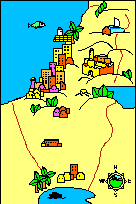 |
A heathen skeptic once scoffed at the claim made by the Sages that millions of Jews once lived in a part of Eretz Yisrael called Har Hamelech; he accused them of being liars because the area could not possibly hold so many people. To this Rabbi Chanina responded with the description given by the Prophet Yirmiyahu of Eretz Yisrael as "the land of the deer." Why is it compared to a deer? When the skin of a deer is removed from its carcass it is impossible to once again have it envelop the deer's flesh, because it has contracted. In similar fashion, when Jews live in Eretz Yisrael the Land expands to absorb them but when they do not live in the Land it contracts.
(Gittin 57a)
|
Written and Compiled by Rabbi Yaakov Asher Sinclair
General Editor: Rabbi Moshe Newman
Production Design: Lev Seltzer
HTML Design: Eli Ballon
© 1997 Ohr Somayach International - All rights reserved. This publication may be distributed to another person intact without prior permission. We also encourage you to include this material in other publications, such as synagogue newsletters. However, we ask that you contact us beforehand for permission, and then send us a sample issue.
This publication is available via E-Mail
Ohr Somayach Institutions is an international network of Yeshivot and outreach centers, with branches in North America, Europe, South Africa and South America. The Central Campus in Jerusalem provides a full range of educational services for over 685 full-time students.
The Jewish Learning Exchange (JLE) of Ohr Somayach offers summer and winter programs in Israel that attract hundreds of university students from around the world for 3 to 8 weeks of study and touring.
Ohr Somayach's Web site is hosted by TeamGenesis
 Copyright © 1997 Ohr Somayach International.
Send us Feedback.
Copyright © 1997 Ohr Somayach International.
Send us Feedback.Dedication opportunities are available for Torah Weekly. Please contact us for details.


