Seasons of the Moon - Elul 5761 / Tishre 5762







August 20 - October 17, 2001
THE
MAN IN THE MOON
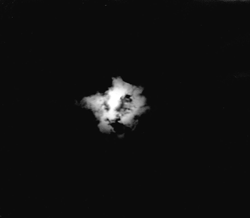
It's uncanny how much the full moon resembles a
human face. It wasn't so long ago that artists routinely depicted the moon as
a man.
In October 1608, the Dutch government debated two patent applications - that
of Hans Lipperhey of Middelburg, and that of Jacob Metius of Alkmaar. The application
was for a device for "seeing faraway things as though nearby." It
consisted of a convex and concave lens in a tube which magnified objects three
or four times.
The news of this new invention spread rapidly through Europe. By April 1609
three-powered spyglasses could be bought in spectacle-maker's shops on the Pont
Neuf in Paris, and four months later there were several in Italy. Later that
year, Thomas Harriot took his six-power telescope and pointed it at the Moon.
And that was the end of the Man in the Moon.
With the advent of the telescope, the Man in the Moon was struck a mortal blow.
Now it was revealed for all to see that the "face" of the moon was
not a face at all but an agglomeration of inert rock and dust.
Do We Know What We See? Or Do We See What We Know?
The Man in the Moon may have passed into folklore, but in some very fundamental ways, he is still very much with us.Look at the world. Do you know what you see? Sometimes it's difficult to be sure exactly what you're looking at. Preconceptions can often lead our eyes astray. Is the world really the way we see it? Do we recognize what's in front of our eyes? Or are we creating a virtual reality based on what our eyes expect to see?
In other words, do we know what we see? Or do we see - what we know?
The Way Of The World
Nothing, it would seem, is more incontrovertible than our own existence. I exist. I am here. I am an independent reality. Aren't I?Twice a day, a Jew covers his closed eyes with his right hand and proclaims "Shema Yisrael, Hashem Elokenu, Hashem Ehad!" "Hear O Israel, Hashem our G-d, Hashem is One!" When we say that G-d is One, we are not just declaring that there is only one G-d; we are affirming that nothing else exists except for Him or outside Him whatsoever. Nothing. His is a Oneness that allows for no "other."
When a Jew says Shema he gives over his very existence to the Creator. He declares that, on the ultimate level, he has no separate existence whatsoever.
The message of Shema runs counter-intuitive to everything that our eyes tell us. Our physical senses do not teach us that nothing else exists except for Him. Quite the reverse. Our senses tells us that if anything exists at all - it's me. From my point of view, the world could be an Ultra-High-Definition 3D movie with SurroundSound. My instinctive perception is that nothing else exists except for me. The Shema is the way we reverse this paradigm; the Shema is the way the Jew 'sees' beyond the picture that his five senses paint.
Sense Beyond Perception
How, you will ask, can we perceive something that is beyond our senses? If our senses are the sole agents of perception, how can we perceive anything beyond them? More - how can we perceive something that totally contradicts them?The Torah teaches us that there is an extra-sensory perception, a channel to that higher reality:
"A G-d of faith and lacking sin; Righteous and Straight is He." (Devarim 32:4)
A cursory reading of this verse would suggest that "a G-d of faith" means that G-d keeps his word, that He's "faith"-ful. However, there is another, deeper meaning here.
"A G-d of faith" means that G-d "believed in the world and created it." What does it mean that G-d "believed" in the world? Surely it is the world that believes (or doesn't believe) in G-d - not the reverse?
A World Called Emuna
Before this physical creation, G-d created another existence, another world. The name of that world is Emuna - belief.When the Torah teaches us that "G-d believed in the world and created it," it means that before this creation, G-d brought into being an existence called Emuna, and within the boundaries of Emuna, within that non-physical world, G-d created the universe. In other words, this entire physical existence from its absolute beginning till its ultimate end is created within, and depends upon, another system. Not a solar system. Not a galactic system. A system called Emuna. Contained within that world is all of this world. Nothing can exist outside of Emuna.
The Other End of the Telescope
When we look at the world through physical eyes, it seems that the world's existence is self-evident, and within the world is a thing called belief, Emuna. Furthermore, our physical eyes would tell us that Emuna is optional: You can choose to believe, or you can choose not to believe. This is the way the rest of the world looks at reality. From the Jewish perspective, however, the world is looking through the other end of the "telescope". The world has mistaken that which is optional for that which is perforce, that which is necessary for that which is incidental. The world has mistaken the rocks and dust of this world for the Man in the Moon. Judaism takes the world's view of itself and reverses it. It takes the telescope and turns it around.Judaism sees that Emuna doesn't exist in the world - the world exists in Emuna.
Solid As A Rock
We tend to think that nothing is as solid as a rock. Nothing is as certain as what our eyes see. We think that these are the certainties - and Faith, Emuna, is not something "certain." The world's paradigm is that Emuna is something we can choose to subscribe to like some ultimate cable channel from the world above. You can channel hop. Or you can just turn the whole set off.The reverse is true. G-d created Emuna as a truth, a reality, and then placed within that creation every rock and mountain, every sea and shore.
The Day Of The King
It is with this sensitivity that a Jew draws close to Rosh Hashana.Rosh Hashana is the day that we crown the Creator as King of the world. What does it mean to crown a non-physical, non-spiritual Being of whom we can ultimately know nothing? Where is there a stadium that can contain His coronation? Where is there a crown large enough to place on His Head?
The crown that we give to the Almighty is our gift of ourselves to Him. When we place our very existence within the world called Emuna, we place the Crown on the Creator.
The Moon In The Man
|
You have left Your Footprints |
SEASONS OF THE MOON is written by Rabbi Yaakov Asher Sinclair and edited by Rabbi Moshe Newman.
Designed and Produced by the Office of Communications - Rabbi Eliezer Shapiro, Director
Production Design: Michael Treblow
© 2001 Ohr Somayach International - All rights reserved. This publication may be distributed to another person intact without prior permission. We also encourage you to include this material in other publications, such as synagogue newsletters. However, we ask that you contact us beforehand for permission, and then send us a sample issue.
This publication is also available in the following formats:
![[Text Format]](/seasons/5762/..\..\image\ascii.gif)
![[Acrobat]](/seasons/5762/..\..\image/pdficon.gif)
Explanation of these symbols | Seasons of the Moon Archives | This publication is available via E-Mail
Ohr Somayach Institutions is an international network of Yeshivot and outreach centers, with branches in North America, Europe, South Africa and South America. The Central Campus in Jerusalem provides a full range of educational services for over 685 full-time students.
The Jewish Learning Exchange (JLE) of Ohr Somayach offers summer and winter programs in Israel that attract hundreds of university students from around the world for 3 to 8 weeks of study and touring.
 Copyright
© 2001 Ohr Somayach
International. Send us Feedback.
Copyright
© 2001 Ohr Somayach
International. Send us Feedback.


