Seasons of the Moon - Shevat 5757







Shevat 5757 / 9 January 1997 - 6 February 1997
This publication is also available in the following formats:
![[Text Format]](/seasons/5757/../../image/ascii.gif)
![[Acrobat Format]](/seasons/5757/../../image/pdficon.gif)
Explanation of these symbols | Subscription Information | Seasons of the Moon Archives

THIS MONTH'S SIGN
AQUARIUS/THE PITCHER
What is the connection between the Jewish People and a pitcher? Just as the only purpose of a pitcher is to be a vessel to carry water, so too the only purpose of the Jewish People is to be the 'Water Carrier' - the vessel of the living waters of the Torah.
Just as a person cannot live without water, so too the Jewish People cannot survive without the Torah.
When we look at our history, it is clear that what has kept us a nation during 2,000 years of Diaspora has been our devotion to the Torah and our precise observance of it.
Also, just as water always finds the lowest place, so too the
Torah can only be absorbed by someone who is truly humble.
YOU ARE WHAT YOU EAT!
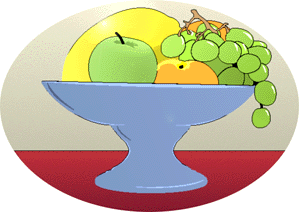 Your body is designed to be the servant of your soul. It is the intermediary between the inner and the outer worlds. Naturally,
a servant can be willing and pliant, or coarse and obstructive.
Your body is designed to be the servant of your soul. It is the intermediary between the inner and the outer worlds. Naturally,
a servant can be willing and pliant, or coarse and obstructive.
Just as a craftsman needs the best tools to produce fine work, likewise the human soul requires a pure body to execute its appointed task. Forbidden food, food which is not kosher (lit. 'fit') contaminate the soul so that holiness will not flow through the body. It renders the body obtuse and insensitive to spirituality.
The foods that the Torah permits heighten Man's awareness of the Divine, and his desire and ability to serve his Creator.
Everything physical owes its existence to a holy spark buried
within it. When you eat, your body extracts the physical nutrients
from the food. But there is something else that is actually keeping
you alive, because "Man does not live by bread alone, but
by all that which emanates from the mouth of Hashem." Hashem
has placed Divine life-sustaining sparks into food. These sparks
that keep us alive.
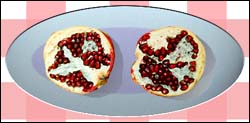 On Tu B'Shevat (15th Shevat/22-23 January), we rejoice over the fruits of the Land of Israel, which are filled with these Divine
sparks.
On Tu B'Shevat (15th Shevat/22-23 January), we rejoice over the fruits of the Land of Israel, which are filled with these Divine
sparks.
There are seven species for which the Land of Israel is praised - food made from the wheat, barley, wine, grapes, figs, pomegranates, olives and dates.
After eating any of these, we make a special blessing for the produce of the field and the desirable, good and spacious land that Hashem saw fit to give to our forefathers.
Even within the Land of Israel, the fruit of some places is more full of kedusha (holiness) than others. The locale with the greatest potential for holiness is the land around Tiberias. Just as a baby in the womb derives nourishment through its umbilical cord and its navel, so too the 'navel' of Eretz Yisrael, the place from which the land derives its kedusha, is the province of the tribe of Naftali, the valley of Ginnosar, and the city of Tiberias. The name 'Tiberias' comes from the Hebrew word tabur, which means 'navel'. And the word Ginnosar means 'Garden of Princes.'
Who were these princes that visited Ginnosar? They were
the aristocracy of the Torah world - its Torah sages. The sages
would journey to partake of its fruits.
 The Talmud relates that Rabbi Abahu ate of these fruits until
a fly would slip off his forehead. Rashi explains that he became
exhilarated when he ate; and his face shone to such an extent
that a fly would slip off his smooth forehead.
The Talmud relates that Rabbi Abahu ate of these fruits until
a fly would slip off his forehead. Rashi explains that he became
exhilarated when he ate; and his face shone to such an extent
that a fly would slip off his smooth forehead.
The fly is a symbol of impurity and sin. It is repelled by someone of intense holiness. The prophet Elisha was recognized as a holy man, "because no fly ever flew over his table."
When Rabbi Abahu ate of the fruits of Ginnosar, quite possibly
on Tu B'Shvat itself, he experienced a heightened spirituality
which brought a spiritual sheen to his 'forehead.' His wisdom
and holiness were so intense that they repelled the dark forces,
symbolized by the fly.
SEEING AND BELIEVING

"If I'd seen the parting of the Red Sea, then I'd also believe in G-d! If G-d wants me to believe in Him, why doesn't He reveal Himself to me like He did to the Children of Israel at the Red Sea?"
Sounds familiar?
After the Six Day War, you couldn't get a pair of tefilin in Israel. Boxes of second-hand tefilin were sent from the States. Everywhere there was a sense of a miraculous delivery.
After the Gulf War, we rushed to tear the plastic sheeting from the windows of our 'sealed rooms.' It was Shushan Purim, and the 'coincidence' was striking: Haman and Saddam, defeated on the same day!
Taxi drivers quoted verses from the prophets about sealed rooms. Everyone saw the Hand of G-d. And yet... Two or three weeks later, the glow had faded and what had been an unforgettable encounter with Divine Providence had been replaced with the usual bickering in the supermarket.
At the Red Sea, the humblest member of the Jewish people - a maidservant - had a greater vision of the Divine than the prophecy of the prophet Yechezkel. And Yechezkel saw the mystical workings of how Hashem runs the world.
And yet, a few short weeks later, these same Children of Israel had fallen prey to an idol.
How was this all possible?
A maidservant remains a maidservant, and a taxi driver a taxi driver, unless...
One of the lessons that we can learn from the incident of the golden calf is that miracles by themselves don't change you.
Unless we take the inspiration of the moment and turn into concrete changes in our behavior, we will stay who we are, with the same limited vision that we had before the miracle.
If we don't work on who we are, we may experience the miraculous in our lives, we may experience great awakenings. But without the hard work of character improvement, we will not be able to hang on to the inspiration of the moment; and we will return to the slumber of unawareness.
Shabbat Shira - The Sabbath of Song - when we read the Song that the Children of Israel sang after crossing the Red Sea is on 17th Shevat / January 25th
SHEVAT
Crown of Torah
Eating / Taste
Time of Delight / Chrysolite
Pure Olive Oil
House of love / Friends
Making Happy / Asher / Bless
Time of clear rational thinking
Time of spiritual and
intellect revolving
Time of selfless giving
and serving.
Shevat.
SOURCES:
- THIS MONTH'S SIGN - Bnei Yissaschar; Ruach Hachaim
- YOU ARE WHAT YOU EAT! - 'Fruit for the Soul' by Rabbi Avrohom Chaim Feuer in The Jewish Observer, January 1986
- SEEING AND BELIEVING - Rabbi Chaim Shmuelevitz
SEASONS OF THE MOON is written by Rabbi Yaakov Asher Sinclair and edited by Rabbi Moshe Newman.
Designed and Produced by the Office of Communications - Rabbi Eliezer Shapiro, Director
Production Design: Lev Seltzer
HTML Design: Michael Treblow
Digital Artwork by Yonah Roberts
© 1997 Ohr Somayach International - All rights reserved. This publication may be distributed to another person intact without prior permission. We also encourage you to include this material in other publications, such as synagogue newsletters. However, we ask that you contact us beforehand for permission, and then send us a sample issue.
This publication is available via E-Mail
Ohr Somayach Institutions is an international network of Yeshivot and outreach centers, with branches in North America, Europe, South Africa and South America. The Central Campus in Jerusalem provides a full range of educational services for over 550 full-time students.
The Jewish Learning Exchange (JLE) of Ohr Somayach offers summer and winter programs in Israel that attract hundreds of university students from around the world for 3 to 8 weeks of study and touring.
Ohr Somayach's Web site is hosted by TeamGenesis
 Copyright © 1997Ohr Somayach International.
Send comments to: ohr@ohr.edu
Copyright © 1997Ohr Somayach International.
Send comments to: ohr@ohr.edu

