Seasons of the Moon - Kislev 5757


Kislev 5757 / November 12 - December 10, 1996
This publication is also available in the following formats:
![[Text Format]](/seasons/5757/../../image/ascii.gif)
![[Acrobat Format]](/seasons/5757/../../image/pdficon.gif)
Explanation of these symbols | Subscription Information | Seasons of the Moon Archives
THIS MONTH'S SIGN
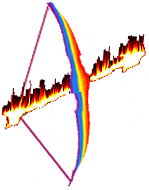
KESHET / SAGITTARIUS
Kislev's sign is the Bow (Keshet in Hebrew). At the beginning of Kislev the first rainbow was seen after the Flood. The rainbow symbolizes the pact that G-d made with Noah never again to destroy the world with water. The symbolism of the bow also echoes the military victory of Chanukah - the bow of purity of Israel vanquishing the bow of impurity of Greece.
Mystically, the bow symbolizes the power of prayer: The closer
the bow-string is drawn downward, the higher the arrow soars skyward;
similarly, the deeper the source of a prayer, the higher it reaches
into the heavens.
TRUTH AND BEAUTY
At this point in the year, when time is measured by how many shopping days are left... the Jewish person often finds himself re-defining who he is in relationship to his Judaism. The festival of Chanukah - the most noticeable aspect of Kislev, is all about redefining and rededicating ourselves to the values and principles of Judaism. The word Chanukah itself means dedication.
 Peter Finch, the Oscar-winning Australian film actor, once remarked
"When you move an eyebrow in Cinemascope it travels three
feet..." Our age is unique in the way we place importance
on the way things look, on their external appearance: Whether
that appearance is the carefully groomed lines of a Lexus sedan,
or the mandatory shape of the human anatomy painfully carved in
sweat and toil of so many man-hours of aerobics. We live in a
world that is replacing substance with form, reality with appearance.
Peter Finch, the Oscar-winning Australian film actor, once remarked
"When you move an eyebrow in Cinemascope it travels three
feet..." Our age is unique in the way we place importance
on the way things look, on their external appearance: Whether
that appearance is the carefully groomed lines of a Lexus sedan,
or the mandatory shape of the human anatomy painfully carved in
sweat and toil of so many man-hours of aerobics. We live in a
world that is replacing substance with form, reality with appearance.
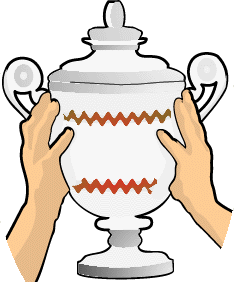
In his Ode on a Grecian Urn, John Keats, the English Romantic poet, wrote "Beauty is Truth, Truth, Beauty." Truth and Beauty - two values representing a historic and perpetual confrontation between the People of the Book and The "Beautiful People," - between Jerusalem and Athens.
It is interesting that Keats chose to write his poem on a Grecian urn, for it was Greece that gave the world the idea that Beauty is, in itself, a supreme ideal. Judaism says that this ideal can become an idol. If Beauty doesn't dwell in the tents of Truth, then 'Beauty' may become a 'Beast' - a pretext for hedonism and immorality.
But don't think that there is no place for Beauty in the Jewish
world-view. The Torah states categorically that aesthetics has
a value, but only to the extent that it serves Truth, and uplifts
the soul. In other words, Truth is Beauty, but what is beautiful
may not necessarily be true. When you gaze into the light of your
Chanukah candles, remember that their light shines out with the
radiance of the Jewish love for Truth in all the ages.
THE NINTH DAY OF CHANUKAH
 Why don't we keep nine days of Chanukah outside the Land of Israel?
After all, if in London and New York we keep eight days of Pesach as opposed to seven days in Israel, why don't we also add a day onto Chanukah? Come to think of it, why don't we also keep two days of Purim?
The Land of Israel is like a giant dynamo, pumping the spiritual energy that keeps the whole world turning. When a person is in Eretz Yisrael, he absorbs spirituality much more easily than in the rest of the world.
So, outside of the Land of Israel we are given a second festival day which helps us to absorb their holiness in a way that could not be achieved in one day alone.
This is the case with the Torah festivals of Pesach, Shavuot and Succot, which Hashem gave us. On these festivals, the holiness comes from above and reaches downward to the earth.
But Chanukah and Purim represent Israel's aspiration to lift itself out of this physical world toward the heavens - the striving from below upward.
Through our own deeds we earned the festivals of Chanukah and Purim. Thus, their sanctity is much more accessible to us. They are close to our inner soul and we are able to experience them equally, wherever we are in the world.
The lights of Chanukah are as bright for us in Los Angeles as
they are in the Holy City of Jerusalem.
THE LIGHT OF LIFE
 Imagine that someone gives you a million dollars to invest. You're
pretty smart and make a few good investments, and very soon, the
million is worth ten million.
Imagine that someone gives you a million dollars to invest. You're
pretty smart and make a few good investments, and very soon, the
million is worth ten million.
Obviously you have to give the original million dollars back to your benefactor, but you do get to keep the other nine million.
It's the same way with the festivals: Hashem gave us Pesach, Shavuot and Succot as gifts - we didn't deserve them - they are a free hand-out - a million dollar gift. However, Chanukah and Purim were earned by the Jewish People.
The Jewish People earned Chanukah because they were prepared to give up their lives in battle to preserve the purity of the Torah. Purim was the reward for the voluntary acceptance of the Oral Law in the time of Mordechai and Esther.
There's an interesting parallel here: The 'weapons' that Israel employed to fight the threat of physical genocide at the time of Purim were spiritual - fasting, prayer and repentance. Whereas, at the time of Chanukah, the threat to Israel was spiritual genocide - the Greeks wanted to uproot the faith of Israel, to darken the eyes of the Jewish People by removing the light of Torah. What was the response to this spiritual assault? Physical warfare.
It's as though we say to Hashem "Your light is in our hands, and our light is Your hands."
When we guard Hashem's light - the light of Torah - by showing that we are prepared to give the light of our lives for it, as was the case during the Maccabean war of Chanukah, Hashem guards the light of our lives.
Similarly, when our enemies seek to extinguish the light of our
lives, as at the time of Purim, our salvation comes by way of
guarding Hashem's light - Torah and mitzvot - and thus
Hashem turns to our petition and guards the light of our lives.
"Your light is in our hands, and our light is
Your hands."
THE
CHANUKAH
BUSH
It's only a silent night.
But one little flask of oil ignored
One little point of light undimmed
Shines on in every heart
It's only an electric glow
of winking, twinkling little stars
darkening your home.
in the florescent screaming
in all the dreaming
in the holy of holy places,
untouched, undimmed, unsullied,
outshining the biggest, brightest
Chanukah bush.
SOURCES:
- SOURCES: THIS MONTH’S SIGN - Shem MiShmuel, Rabbi M. Glazerson
- THE LIGHT OF LIFE; THE NINTH DAY OF CHANUKAH - Rabbi Eliyahu Kitov
SEASONS OF THE MOON is written by Rabbi Yaakov Asher Sinclair and edited by Rabbi Moshe Newman.
Designed and Produced by the Office of Communications - Rabbi Eliezer Shapiro, Director
Production Design: Lev Seltzer
HTML Design: Michael Treblow
Bow & Dreidel Design: Yonah Roberts
© 1996 Ohr Somayach International - All rights reserved. This publication may be distributed to another person intact without prior permission. We also encourage you to include this material in other publications, such as synagogue newsletters. However, we ask that you contact us beforehand for permission, and then send us a sample issue.
This publication is available via E-Mail
Ohr Somayach Institutions is an international network of Yeshivot and outreach centers, with branches in North America, Europe, South Africa and South America. The Central Campus in Jerusalem provides a full range of educational services for over 550 full-time students.
The Jewish Learning Exchange (JLE) of Ohr Somayach offers summer and winter programs in Israel that attract hundreds of university students from around the world for 3 to 8 weeks of study and touring.
Ohr Somayach's Web site is hosted by TeamGenesis
 Copyright © 1996 Ohr Somayach International.
Send comments to: ohr@ohr.edu
Copyright © 1996 Ohr Somayach International.
Send comments to: ohr@ohr.edu

