Light Lines - Yisro







20 Shevat 5759 February 6, 1999 Parshat Yisro

"You shall not covet." (Exodus 19:14)
How is it possible to command people not to covet? Coveting is a knee-jerk reaction, isn't it? You see someone driving along in a Mercedes 500LS and before you can even think twice, your envy-glands go into overdrive. Covetousness is a reflex. It's not in the domain of intellectual control, is it?
Once there was a peasant who stood in line all day to see the king pass by. At last, the royal procession drew close. He craned his neck to catch a glimpse of the royal countenance. Immediately behind the king stood the crown princess. The peasant was stunned. The princess was the most beautiful woman he had ever seen. She had delicate pale features. All the women he knew had coarse sun-browned skin and bad teeth. After all, a peasant's life is not exactly conducive to physical beauty.
However, despite the princess's exquisite appearance, not for one moment did the peasant desire or covet her. She was someone so far above his station in life, that it never entered his mind that he was even in the same world as her. She remained an ethereal unreality in another cosmos.
The root of all desire is the unconscious assumption we could have the object of our desire. If we feel that it's possible for us to have that thing, if we feel that it's within our orbit, the immediate next step is to covet it. The mitzvah of not coveting tells us to look at someone else's Mercedes as a peasant looks at a princess.
"Six days shall you work and accomplish all your work; but the seventh day is Shabbos to G-d..." (Exodus 20:9,10)
A poor villager was trekking the many miles to his destination in the next village. He staggered along under the weight of his pack when suddenly a horse and wagon pulled up alongside him. "Climb aboard!" the wagon driver shouted down to him. The villager huffed and puffed his way up onto the back of the wagon, the driver shook his reins and the horses obediently started to trot.
A few miles down the road, the villager said to the driver "I can't thank you enough. This is really very kind of you!" "Not at all," said the driver and turned to smile at the villager in the back of the wagon. It was then that he noticed that the villager was sitting crumpled forward with his heavy pack still on his back. Exclaimed the driver, "Why haven't you taken your pack off!" The villager replied in all innocence, "Well, you've been so kind carrying me, I didn't want to burden you with the extra weight of my pack as well!"
If G-d can "carry" us all week - making sure that we have food to eat, clothes to wear, cars to drive, and even air to breathe - He can certainly bear the "added load" of supporting us on Shabbos, even if we don't go to work!
Light Insight | Love of the Land | Response Line Ohr Somayach Home Page |
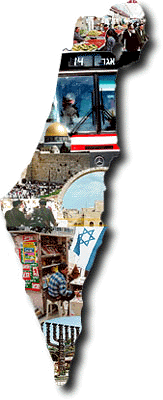  Selections from classical Torah sources which express the special relationship between the People of Israel and Eretz Yisrael Tel Aviv-Jaffa The harbor on which this city was built was the famous gateway to the Land of Israel. The cedars of Lebanon which Hiram, King of Tyre, sent to King Solomon for building the Holy Temple and his palace were floated down to the sea till they reached Jaffa. (Chronicles II 2:15) The Sea of Jaffa, say our Sages, is the repository of all the treasures of ships wrecked at sea, and in the hereafter it will yield these treasures to the righteous. The port of Jaffa was the departure point for the Prophet Jonah, whose futile flight from a Divine mission we read about at the Mincha service of Yom Kippur. Jews began returning to Jaffa ("Yafe" in Hebrew means beautiful, and this may be the source of the city's name) in 1840, and subsequent immigration led to the development of colonies in the area, climaxing with the establishment in 1908 of Tel Aviv, which eventually became the major urban center of modern Israel. Tel Aviv is mentioned (Ezekiel 3:15) as a Babylonian city where exiles from Israel had gathered, but its Zionist founders gave this name to the city because it was the title of the Hebrew translation of Herzl's "Altneuland." The emblem of Tel Aviv-Jaffa is a lighthouse and a gate, symbols of the city's historic role as the gateway to the Land of Israel. |
Light Insight | Love of the Land | Response Line Ohr Somayach Home Page |

Lee Kong Giap wrote:
Dear Rabbi,Dear Lee Kong,Is the word "hallelujah" constructed by four words or one word? Because it is constructed by four words in Chinese, and I hear my teacher said "halle" means praise, "lu" means "your," "Jah" means "G-d," and the word "Hallelujah" sounds a bit commanding. It that true? Does the word comes from Hebrew or Greek? I look forward to your reply.
The word "halleluyah" mentioned in Psalms is the Hebrew word for requesting a congregation to join in praise. "Hallel" means to recite praise, "hallelu" is the plural form. The grammatical extension "yah" is a way of expressing magnanimity. For example "merchav" means space, "merchavyah" means a vast space (Psalms 118:5); "shalhevet" means flame, "shalhevetyah" means a colossal flame (Song of Songs 8:10). Hence, halleluyah means "a great praise."
There are other ways of interpreting this word, as the Hebrew language does include the possibility for many meanings in the same word. For example, it is also understood to mean "praise G-d," since the last letters "yah" are also one of G-d's names.
Mimi Katz wrote:
Dear Rabbi,Dear Mimi Katz,If, in Hebrew, "good morning" is "boker tov," "good evening" is "erev tov," and good night is "lailah tov," then why is "good afternoon" said in the plural "tzohorayim tovim?"
Nachmanides in his commentary on the Torah addresses this question. He explains that the singular, tzohar, means "light" (compare the word zohar which means "shining"). Noon is called tzohorayim, "lights," in the plural for the following reason: In the morning when the sun is in the east, there is a shadow on the west side of objects. In the afternoon when the sun is in the west, there is a shadow on the east side of objects. Only at noon, when the sun is directly overhead, is there no shadow, neither to the east nor to the west of objects. Both sides are light, hence, noon is called "tzohorayim" in the plural to indicate a time of total light.
Produced by the Office of Communications
Editor: Raphael Scott Leban
Production: Eliezer Shapiro
Light Insight: Michael Treblow
HTML Production: Eli Ballon
© 1999 Ohr Somayach International - All rights reserved. This publication may be distributed to another person intact without prior permission. We also encourage you to include this material in other publications, such as synagogue newsletters. However, we ask that you contact us beforehand for permission, and then send us a sample issue.
This publication is available via E-Mail
Ohr Somayach Institutions is an international network of Yeshivot and outreach centers, with branches in North America, Europe, South Africa and South America. The Central Campus in Jerusalem provides a full range of educational services for over 685 full-time students.

 Copyright
(c) 1999 Ohr Somayach International. Send
us Feedback.
Copyright
(c) 1999 Ohr Somayach International. Send
us Feedback.


