Light Lines - Yisro





4 Adar 5759 February 20, 1999 Parshat Terumah

In the desert kingdom of Mukhtar, things changed a lot after they discovered the oil.
The sheik, eager to benefit his people and to add to his own prestige, built roads and hotels, palaces and airports. They had everything. Everything, that is, except water. The only liquid that was abundant in Mukhtar was black and viscous. It may have been black gold - but you still couldn't drink it.
Short of towing an iceberg from the Antarctic (an idea which was under consideration), no-one had yet found a solution.
The sheik decided that he himself would go to America, for America was a country where there were solutions for people who didn't even know they had problems.
The sheik stayed in the Waldorf Astoria for under a week. When it was time to leave, he summoned the bell-hop to take down his luggage."They shall make an ark..." (Exodus 25:10)
In the desert kingdom of Mukhtar, things changed a lot after they discovered the oil.
The sheik, eager to benefit his people and to add to his own prestige, built roads and hotels, palaces and airports. They had everything. Everything, that is, except water. The only liquid that was abundant in Mukhtar was black and viscous. It may have been black gold - but you still couldn't drink it.
Short of towing an iceberg from the Antarctic (an idea which was under consideration), no-one had yet found a solution.
The sheik decided that he himself would go to America, for America was a country where there were solutions for people who didn't even know they had problems.
The sheik stayed in the Waldorf Astoria for under a week. When it was time to leave, he summoned the bell-hop to take down his luggage.
The bell-hop's jaw dropped when he opened the door to the sheik's suite.
There, sitting in the middle of the state-room, was an enormous sea-trunk. It was so improbably large that it looked almost like a stage-prop. Realizing that he was easily out-manned by such an object. He retreated and returned with reinforcements.
It finally took six able-bodied porters and a truck to move the trunk out to Kennedy airport.
In an era of roll-on luggage, the sheik's cabin trunk looked like an anachronism. And sure enough, it caught the eye of a watchful customs officer.
"Good morning, sir! May I ask you what you have in this trunk?"
"Oh it's nothing officer, just a few presents for my people back home."
"Yes sir... Would you mind opening it up, please?"
"Well really officer, this is most unnecessary. I will take this up at the highest levels."
"That's your privilege, sir, but I'm afraid you'll still have to open this trunk."
When the lid of the trunk opened, the officers eyes widened in disbelief.
The entire trunk was filled with taps, faucets of all kinds and shapes, stainless steel, copper, modern, antique. Nothing but faucets. Faucets and faucets...and more faucets.
"You see officer, in my country, we have no water. On my first day in this country, I went into the kitchen and turned one of these things, and miracle of miracles, water just started to pour out of it! So now, I am taking home to my people this brilliant invention. You westerners know a thing or two, I have to admit!"
G-d told Moses to tell Betzalel, "make Me a mishkan (sanctuary), an ark, and kelim (the furnishings of the sanctuary)." When Moses told Betzalel, he changed the order and told him to build an ark, kelim and a mishkan.
Betzalel said to Moses, "Moses, our teacher, the way of the world is that a person builds a house, and then afterwards furnishes it. You're telling me to build the furnishings first. Where am I supposed to put them?"
Why did Moses change the order?
Moses wasn't giving Betzalel building instructions. He wasn't talking to him like an architect to a building contractor. Moses was speaking conceptually - stressing the essence and purpose of the mishkan.
The ark was the centerpiece of the mishkan. The word for ark, aron, comes from the Hebrew word for light, ohr. The aron was the light of the mishkan for it contained the Holy Torah, which is the light of the world. Without the aron, the mishkan would have been merely a shell - a dry faucet - without the living waters of the Holy Torah.
Light Insight | Love of the Land | The Other Side of the Story Ohr Somayach Home Page |
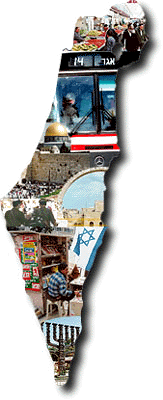  Selections from classical Torah sources which express the special relationship between the People of Israel and Eretz Yisrael Tiberias (Teveriya) This famous city on the shores of Lake Kinneret, sometimes referred to as the Capital of the Galilee, has an interesting history surrounding both its name and its destiny. There are different versions in our classical sources regarding the source of the name Tiberias. The Midrash attributes it to the Roman Emperor Tiberius who named it in his honor. In the Talmud, however, the city's original name is given as Rakkat. The Hebrew name Teveriya is explained to mean the "tabur" - navel - of the land (for after the destruction of Jerusalem the main Jewish community was in Galilee), or that it comes from the phrase "tovah riyasah" - a beautiful sight. Teveriya was the seat of great yeshivos and was the last stop in the ten wanderings of the Sanhedrin (the High Court). Our Sages state that this represented the lowest point in the history of this august body (corresponding perhaps to its altitude below sea-level) and that the Redemption will begin with the reestablishment of the Sanhedrin there before it returns to Jerusalem. Modern Teveriya is a thriving Jewish community which attracts many local and foreign Jewish tourists who come to the Kinneret or to visit the tombs of Rabbi Meir, Maimonides and other distinguished tzadikim buried nearby. |
Light Insight | Love of the Land | The Other Side of the Story Ohr Somayach Home Page |
I once had a shirt that I really loved. One day, I was walking out of my room and I saw my sister wearing the same one. I got upset, and ran to my room. My shirt was missing. I decided not to say anything to my sister, because maybe she had just bought the same shirt, and I didn't know. Later that day my sister came to me with the shirt and said, "Mommy put this in my room by mistake, and I thought it was mine. Sorry."
One day I had a really big test to study for. My sister was listening in the next room to really loud music. I usually go in and scream at her to turn it down, and she gets mad that I yell at her so she purposely doesn't turn it down. This time I realized that maybe if I go in and ask very nicely, she will turn it down. I went in, said "Please," and surely enough, she turned it down for me.
Produced by the Office of Communications
Editor: Raphael Scott Leban
Production: Eliezer Shapiro
Light Insight: Michael Treblow
HTML Production: Eli Ballon
© 1999 Ohr Somayach International - All rights reserved. This publication may be distributed to another person intact without prior permission. We also encourage you to include this material in other publications, such as synagogue newsletters. However, we ask that you contact us beforehand for permission, and then send us a sample issue.
This publication is available via E-Mail
Ohr Somayach Institutions is an international network of Yeshivot and outreach centers, with branches in North America, Europe, South Africa and South America. The Central Campus in Jerusalem provides a full range of educational services for over 685 full-time students.

 Copyright
(c) 1999 Ohr Somayach International. Send
us Feedback.
Copyright
(c) 1999 Ohr Somayach International. Send
us Feedback.


