Light Lines - Rosh Hashana





Rosh Hashana
1 Tishrei 5760 / September 11, 1999
Rosh Hashana Page | Ohr Somayach Home Page

As with most of the wisdom of our Sages, this statement requires insight and elaboration to unlock its hidden depth.
What is the beginning of something? The moment of conception of anything which comes into existence, must contain all the elements of the future of that thing. For example, when a person is conceived, all the person’s genes are fixed — genes that will determine every step of growth and development of the child. All the physical features which will ever manifest themselves in the person are results of those genes. The same is true for all phenomena in the world — their future existence is a reflection of the elements contained, albeit infinitely compressed, in their beginnings.
The initial moment of existence of something, when it transitions from non-existence to existence, is the most potent, important moment. Subsequent stages of early development are critical, but not as critical as the first instant. Later stages are even less critical, and so on, each phase a further revelation of the initial coding. For example, in a fetus, small irregularities that occur at the genetic level will be much more far-reaching than much larger irregularities that occur during embryonic development, and irregularities at an embryonic level will be more far-reaching than mishaps as a grown adult. Therefore, the moment which demands the greatest care, the greatest intensity and the greatest purity, is the very first moment.
Time is also a creation. The Jewish year, with its calendar of seasons and holidays, is an organic entity. Its is "conceived" on Rosh Hashanah, and its initial stage of development lasts for ten days, until Yom Kippur. Since these days are the beginning of our year, the most critical for launching the new year in the right direction, we endeavor with extreme care to try to live correctly from Rosh Hashanah through Yom Kippur. Mistakes made during this phase will be harder to correct later, and efforts made during this phase will reap greater rewards as the year progresses.
The way one begins the year will determine how the rest of the year reveals itself. If one can form the genes of the year correctly, the fetus will develop correctly and the child and adult will be wholesome. Each moment of Rosh Hashanah should be utilized with exquisite care, displaying only positive personality traits, controlling one’s anger and focusing on spiritual growth. Many have the custom not to sleep during the day of Rosh Hashanah, at least not until midday, in order to lay down the genes of the year in consciousness and spiritual effort.
May the conception of the new year be filled with unity, service and peace for all the Jewish People.
|
Rosh Hashana Page | Ohr Somayach Home Page |
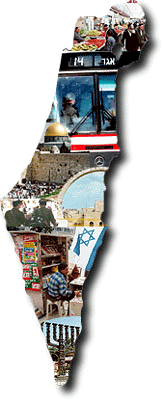  Selections from classical Torah sources which express the special relationship between the People of Israel and Eretz Yisrael Why Not Egypt?
"For the land which you come there to inherit is not like the land of Egypt from which you have gone out..." (Deuteronomy 11:10) Why was it necessary to take the Jews out of Egypt? G-d could simply have destroyed the Egyptians as punishment for their grave sins in enslaving and oppressing Israel and then given their land — a rich, fertile one — to His chosen people? The answer is supplied in the contrast between Egypt and the Land of Israel described in the ensuing passages. Egypt is irrigated once annually by the Nile and does not depend on rainfall, while the Land of Israel is dependent all year round on rainfall that comes as a result of special Divine Providence. It is therefore not a land with just one annual "visit" of G-d, but "a land which G-d seeks constantly, G-d’s eyes are upon it from the beginning of the year until the end of the year." The next passage explains the ongoing relationship of the Jewish People and G-d: "if you will heed the mitzvos which I command you", then "I will give you the rain for your land in its time." The Jewish existence in the Land of Israel is a special one, giving us the opportunity to be in constant interaction with G-d, with regular reward from Him for our Divine service. |
Rosh Hashana Page | Ohr Somayach Home Page |

Know When to Blow
Aaron Ahuvia wrote:
Rosh Hashanah will soon be with us, and this year we will not be blowing the shofar on the first day because it is Shabbat. I would like to understand more deeply why we have this custom. Is it because we don’t use ritual objects on Shabbat? But we read from the Torah on Shabbat? Or is it forbidden like other musical instruments, since if they break you might come to fix them? But how likely is it that a shofar will break?
Dear Aaron,
You’re right, there’s no prohibition against using ‘ritual objects’ on Shabbat. As you said, we read the Torah scroll on Shabbat.
Is the shofar forbidden on a ‘Shabbat Rosh Hashanah’ because of the prohibition against musical instruments? That can’t be the only reason, and here’s why not:
True, on a regular Shabbat, musical instruments - including shofars - are forbidden. But musical instruments are forbidden on Rosh Hashanah, also. So obviously, the mitzva of blowing shofar on Rosh Hashanah is an exception; otherwise, the mitzvah of shofar could never be fulfilled.
Rather, the reason is as follows: Everyone wants to fulfill his obligation to hear the shofar, but not everyone knows how to blow the shofar. Someone might bring his shofar to an expert to learn how, and thereby accidentally desecrate Shabbat by carrying the shofar outside.
I once heard a beautiful idea which can be learned from this Rabbinic decree, an idea especially appropriate for Rosh Hashanah:
One might ask: "How often will it happen that someone forgets it’s Shabbat and carries a shofar outside?"
Not very often.
"How learned is the person for whom the Sages made this decree?"
Not necessarily so learned.
"And how Jewish is the community in which this person lives?"
Not very. There’s not even a synagogue where he can go to hear the shofar blowing.
Nevertheless, the Sages of Israel forfeited their own mitzva - sacrificing their own spiritual elevation and that of the entire nation - for the sake of a simple, perhaps unlearned Jew, living far from the hub of any major Jewish community. They cared about him, concerned that he, too, keep Shabbat properly. This highlights the inseparable connection shared by all Jews, that we should care about each other and unite as one people.
As to your question, "How likely is it that a shofar will break?" I don’t know, but it so happens that last year on Rosh Hashanah my shofar broke. I fixed it after Rosh Hashanah by soaking it in boiling water until it softened, then repaired it and let it harden.
Produced by the Office of Communications
Editor: Raphael Scott Leban
Production: Eliezer Shapiro
Light Insight: Yaakov Asher Sinclair
HTML Design: Michael Treblow
HTML Production: Eli Ballon
© 1999 Ohr Somayach International - All rights reserved. This publication may be distributed to another person intact without prior permission. We also encourage you to include this material in other publications, such as synagogue newsletters. However, we ask that you contact us beforehand for permission, and then send us a sample issue.
This publication is available via E-Mail
Ohr Somayach Institutions is an international network of Yeshivot and outreach centers, with branches in North America, Europe, South Africa and South America. The Central Campus in Jerusalem provides a full range of educational services for over 685 full-time students.
 Copyright
©1999 Ohr Somayach International. Send
us Feedback.
Copyright
©1999 Ohr Somayach International. Send
us Feedback.


