Light Lines - Vayeshev



23 Kislev 5759 December 12, 1998 Parshat Vayeshev
Light Insight | Love of the Land | Response Line Ohr Somayach Home Page |

Beis Shammai claims that we should decrease the number of candles, learned from the bulls that were offered as sacrifices in the Temple on Succot, which were offered in descending order from 13 to 7 on each of the 7 days of Succot. 70 bulls in total were offered each Succot, corresponding to the 70 Nations of the world. The Temple sacrifices, which unlocked a force of blessing from heaven for the entire world, were unfortunately misunderstand by the nations of the world. As a result, the Jewish People have suffered countless pogroms throughout the ages including the destruction of two Holy Temples.
Although the Greeks did not actually destroy our Temple, they did contaminate it. Chanuka celebrates the return of holiness to the Temple after the contamination of the Greeks. Beis Hillel therefore claims that since holiness was returned to the Temple, and since we always move upwards in matters of holiness, then we should increase the candles from one to eight in order to illustrate this increase in holiness.
What underlies their dispute on a deeper level? Chanuka took place in Israel during the Hellenistic oppression known as the Greek Exile. It was further dubbed the 'exile of darkness' because the Greeks made every effort to make Jews see and understand the world in a way which was alien to the Torah. 'Darkness' - because nothing is as dark as the enslavement of the human mind.
There are two ways that you can combat darkness and evil in the world. You can attack them by fighting whatever is wrong in the world, or you can create such a tremendous light that the darkness just fades away. Chanuka expresses the victory of light over darkness, but the question lies in what strategy is most successful: to burn away and destroy evil, or to create a greater light so that the darkness just vanishes?
A flame has two very distinct properties: it can burn, and it can illuminate. In combating evil in the world, do we destroy it, burn it, or do we illuminate Torah creating a greater light in the world to dissipate the darkness? This is the nature of the dispute between Beis Shammai and Beis Hillel. Both methods are valid, but what is the main lesson of Chanuka and the primary way that the Jewish People are a light unto the nations?
Beis Shammai and Beis Hillel agree on the purpose of kindling the menorah - to rekindle in ourselves the light of the triumph over darkness. And they both agree that the number of candles should be different each night to signify that each day of the miracle is unique. But its uniqueness can be expressed either by adding or subtracting a candle each day. Beis Shammai understands that when we fight the negative corrupting aspects of the prevalent pagan world-culture either through sacrifices, (or prayer when we have no Temple) we are steadily wiping out their influence on us, which is reflected in the decreasing pattern of the sacrifices on Succot. Thus, we should light the menorah in the same way: starting with eight and reducing the number of candles each night. In this way, the burning quality of the flame symbolizes the diminishing effect that the negative forces of the world have on us, the destruction of Greek paganism, and ultimately the destruction of evil in the Universe.
On the other hand, Beis Hillel sees the battle against immorality in the world, not as a confrontation, but rather, as an important reason to raise ourselves spiritually, to become the embodiment of morality in the world by living according to Torah principles. This way, the entire world will see us and want to imitate us. Thus, says Beis Hillel, the primary method of wiping out darkness is by increasing the illumination of Torah everywhere, not by burning away evil, but rather by increasing our light as a Torah Nation. For this reason we increase the number of candles each night to remind ourselves of our responsibility, as Jews, to steadily increase the light of Torah knowledge and understanding in the world, banishing the darkness of evil by becoming a light unto the nations.
Adapted from a lecture by Ohr Somayach Founder and Dean, Rabbi Mendel Weinbach
Light Insight | Love of the Land | Response Line Ohr Somayach Home Page |
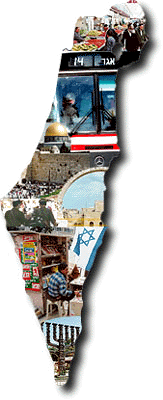  Selections from classical Torah sources which express the special relationship between the People of Israel and Eretz Yisrael Modi'in Modi'in is the historical name of the mountain stronghold of the Maccabeans whose victory over the vastly superior forces of the Hellenist Greek oppressors is celebrated on Chanuka. In his historical account of the that epic struggle between pagan idolatry and Hebrew faith, Josephus describes how the wicked Antiochus ordered his officers to wipe out any trace of Judaism. They did indeed slay anyone who remained faithful to Torah observance, except for those who fled to the mountain area of Modi'in together with Matitiyahu, the son of Yochanan. It was from this Modi'in that Matitiyahu and his five sons led their small band of faithful Jews in a seemingly hopeless war of "the mighty against the weak, the many against the few, the impure against the pure, the wicked against the righteous, the sinners against those who adhered to the Torah" - a war ending in a miraculous victory, climaxed by the miracle of the oil in the Menorah which burned for eight days. Since the Six-Day War, the Modi'in area has been intensely developed and is the home of the rapidly growing town of Modi'in, the religious community of Kiryat Sefer, and the soon to rise community of Ohr Somayach. |
Light Insight | Love of the Land | Response Line Ohr Somayach Home Page |

Helena, wrote:
Dear Rabbi,Dear Helena,What's the source for "Chanuka gelt" - giving money or presents on Chanuka. Does it have a Jewish source, or is it something we copied from others so Jewish kids wouldn't feel left out? Does it have any significance? Thank you.
"Chanuka gelt" is a Jewish custom rooted in the Talmud.
The Talmud states that even a very poor person must light Chanuka lights, even if he can't afford it. A person with no money is required to go "knocking on doors" until he collects enough to buy at least one candle for each night of Chanuka.
The Torah concept of charity - tzeddaka - requires us to help the recipient in the most dignified manner possible. Therefore, the custom arose to give gifts of money during Chanuka so that someone who needs extra money for Chanuka candles can receive it in the form of "Chanuka gelt."
Produced by the Office of Communications
Editor: Raphael Scott Leban
Production: Eliezer Shapiro
HTML Design: Michael Treblow
HTML: Eli Ballon
© 1998 Ohr Somayach International - All rights reserved. This publication may be distributed to another person intact without prior permission. We also encourage you to include this material in other publications, such as synagogue newsletters. However, we ask that you contact us beforehand for permission, and then send us a sample issue.
Ohr Somayach Institutions is an international network of Yeshivot and outreach centers, with branches in North America, Europe, South Africa and South America. The Central Campus in Jerusalem provides a full range of educational services for over 685 full-time students.

 Copyright
(c) 1998 Ohr Somayach International. Send
us Feedback.
Copyright
(c) 1998 Ohr Somayach International. Send
us Feedback.


