Ask the Rabbi #94








Plane Prayer
ContentsAlan Levine from Illinois wrote:
My parents recently flew to Israel on El Al. The airplane was very full and they ended up having to sit in the back in the smoking section and unfortunately had a very bad flight. On top of the smoking and the people marching back and forth to the bathrooms - just when my mother had finally fallen asleep - the people started davening Shacharit [praying the morning service]. My dad said it bothered them and woke my mother up. He said it wouldn't have bothered them if it'd just been quieter. My question is this: Can I pray sitting in my seat if I feel more comfortable? I think I would be able to concentrate better and it wouldn't bother anybody.
Dear Alan,
According to the Shulchan Aruch, someone traveling in a ship and unable to stand may pray while sitting, but must pray over again when he reaches his destination. (Today, however, due to our low level of concentration during prayer, we wouldn't pray over, but rather would rely on the sit-down prayer.)
On a 'jumbo jet', though, there are places where ten or more can stand and pray together, while following common courtesy: Pray quietly, avoid stepping on toes, don't block the bathroom or aisle, etc.
To find out El Al's official policy towards in-flight prayer groups, I called their assistant director of public relations. The official told me, "El Al is a Jewish airline. We have never stopped this [people praying with a minyan] ... We do know that people are complaining about this." If enough people were to congregate and cause a noticeable weight imbalance, the captain would be obligated by international aviation regulations to disperse them, said the official, but this never actually happens.
I asked Rabbi Chaim Pinchas Scheinberg, shlita, if one should pray with a minyan on an airplane. He said yes, adding that he does it "all the time." While strictly speaking it might be permitted to pray at your seat, Rabbi Scheinberg prefers that one pray with a minyan, but quietly in a way that doesn't disturb others.
True story: Two rabbis I know were flying from one city to another somewhere in America's 'Wild West'. Heavy turbulence caused one passenger --- a first-time flyer --- a great deal of fear and anxiety. Just as the flight attendant succeeded in reassuring him that all was normal, it came time for afternoon prayer. The rabbis got up, put on their hats and jackets, and headed towards the back of the plane. Seeing this, the frightened passenger became hysterical, saying, "You see! You see! Those guys are getting off!"
Sources:
- Shulchan Aruch Orach Chaim 94:4,9
Two Shins
ContentsJulian Freedman of Institute of Management Accountants wrote:
The head Tefillin has the Hebrew letter 'shin' embossed twice on it. One of them is written normally with three branches, and the other one has four branches. Why?
Thank you!
Tefillin embody the entire Torah. According to the verse, Tefillin enable "the Torah of Hashem to be in your mouth." The two different shins represent the two ways the Torah was written: In stone and upon parchment.
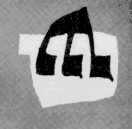 Hashem told Moses to
write a Torah scroll using ink and parchment. This Torah was written
as we write it today --- i.e., with the 'normal' three-pronged
shin. The letters engraved on the tablets, on the other
hand, were formed by empty space --- this empty space is legible
due to the outline formed by the remaining stone. The four-pronged
shin represents the outline of the shin engraved on the
tablets. By the way, this is the only instance of a four-pronged
shin.
Hashem told Moses to
write a Torah scroll using ink and parchment. This Torah was written
as we write it today --- i.e., with the 'normal' three-pronged
shin. The letters engraved on the tablets, on the other
hand, were formed by empty space --- this empty space is legible
due to the outline formed by the remaining stone. The four-pronged
shin represents the outline of the shin engraved on the
tablets. By the way, this is the only instance of a four-pronged
shin.
This teaches us that if we learn Torah (the three-pronged
shin of the scroll written by Moses), Hashem will give
us the gift of understanding (the unique four-pronged shin
of the Tablets, which were given as a gift to the Jewish people).
Sources:
- Hagahot Semag, cited by Beit Yosef, Orach Chaim 32
Answer to Yiddle Riddle
ContentsLast week we asked: What is the longest Birkat HaMazon? What can make it longer?
Answer: When Rosh Chodesh Tevet falls on Shabbat, the Birkat HaMazon contains additions for Rosh Chodesh, Shabbat and Chanukah. It is even longer after a meal celebrating a Brit Milah, in which case there is an addition to the Zimun (introduction) and extra 'Harachamans' (special supplications).
- Written by Rabbi Moshe Lazerus, Rabbi Benzion Bamberger, Rabbi Reuven Subar,
Rabbi Avrohom Lefkowitz and other Rabbis at Ohr Somayach Institutions / Tanenbaum College, Jerusalem, Israel.
- General Editor: Rabbi Moshe Newman
- Production Design: Lev Seltzer
- HTMIL Design: Michael Treblow
© 1995 Ohr Somayach International - All rights reserved. This publication may be distributed to another person intact without prior permission. We also encourage you to include this material in other publications, such as synagogue newsletters. However, we ask that you contact us beforehand for permission, and then send us a sample issue.
This publication is available via E-Mail
Ohr Somayach Institutions is an international network of Yeshivot and outreach centers, with branches in North America, Europe, South Africa and South America. The Central Campus in Jerusalem provides a full range of educational services for over 685 full-time students. The Jewish Learning Exchange (JLE) of Ohr Somayach offers summer and winter programs in Israel that attract hundreds of university students from around the world for 3 to 8 weeks of study and touring.
 Copyright © 1995
Ohr Somayach International.
Send us Feedback.
Copyright © 1995
Ohr Somayach International.
Send us Feedback.Dedication opportunities are available for Ask The Rabbi. Please contact us for details.


